BS Chemistry in Pakistan 2026 – Scope, Subjects, Admission, Fees
BS Chemistry in Pakistan 2026 – Scope, Subjects, Admission, Fees & Jobs
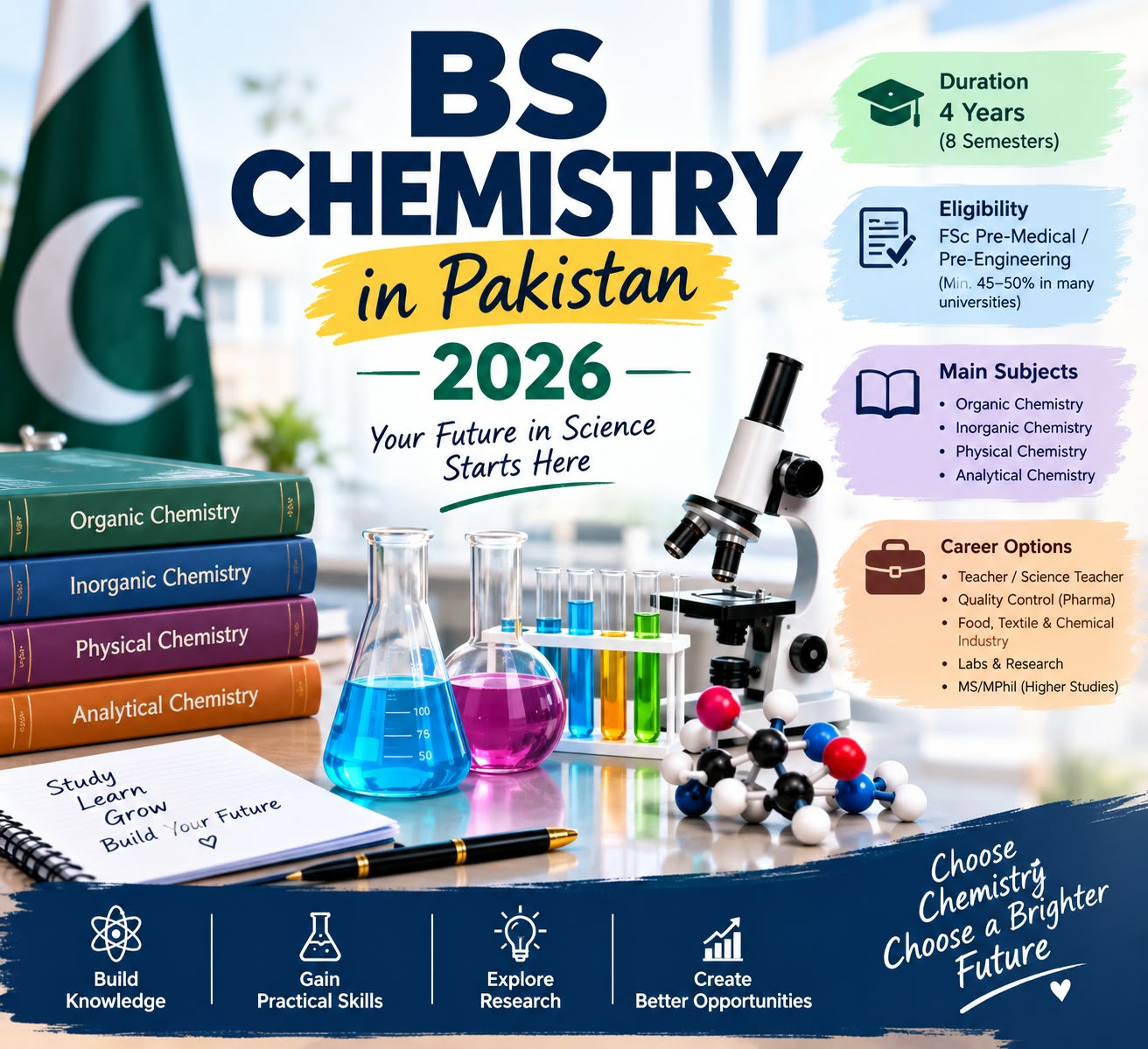
BS Chemistry in Pakistan 2026: is a four-year undergraduate degree program designed for students who want to understand chemical substances, laboratory processes, scientific research, and the practical applications of chemistry. The program is a suitable option for students interested in science, pharmaceuticals, chemical industries, environmental studies, and research.
Many Pakistani universities offer chemistry-related degree programs with a combination of classroom learning, laboratory experiments, and research activities. Students learn about the composition, structure, properties, and reactions of matter while developing analytical and problem-solving skills.
If you have completed intermediate education and want to build a career in science, a BS Chemistry degree can open pathways to employment, postgraduate education, and specialized research. This guide explains the admission requirements, subjects, fee structure, career opportunities, and future scope of BS Chemistry in Pakistan in 2026.bs chemistry scope in pakistan
What Is BS Chemistry?
BS Chemistry is a bachelor’s degree that focuses on the scientific study of matter and the chemical changes that take place in different substances. It helps students understand how chemicals interact and how chemistry is used in industries, healthcare, agriculture, environmental protection, and scientific research.
The degree usually takes four years to complete, depending on the university’s semester system and academic regulations. Students study theoretical concepts alongside laboratory work to gain practical experience in chemical analysis, experimentation, and scientific reporting.
BS Chemistry may be offered through public and private universities. Before applying, students should verify the institution’s recognition, curriculum, laboratory facilities, and admission requirements.
BS Chemistry Admission Requirements in Pakistan 2026
Students interested in BS Chemistry should review the eligibility criteria of their preferred university before submitting an application.
Common admission requirements may include:
- Completion of Intermediate or an equivalent qualification.
- FSc Pre-Medical, FSc Pre-Engineering, or another accepted science qualification, depending on the university.
- Meeting the university’s minimum marks requirement.
- Providing academic transcripts, certificates, and other required documents.
- Passing an entry test or interview if required by the institution.
Eligibility requirements are not identical across all universities. Some institutions may accept specific combinations of science subjects, while others may have additional conditions.
Students should check the latest admission notice on the official university website to confirm the required marks, application deadline, merit criteria, and available seats.
BS Chemistry Subjects and Course Outline
The BS Chemistry curriculum generally covers the major branches of chemistry and develops students’ laboratory and research skills. The exact course outline varies according to the university and its approved curriculum.
Common subjects may include:
1. Organic Chemistry
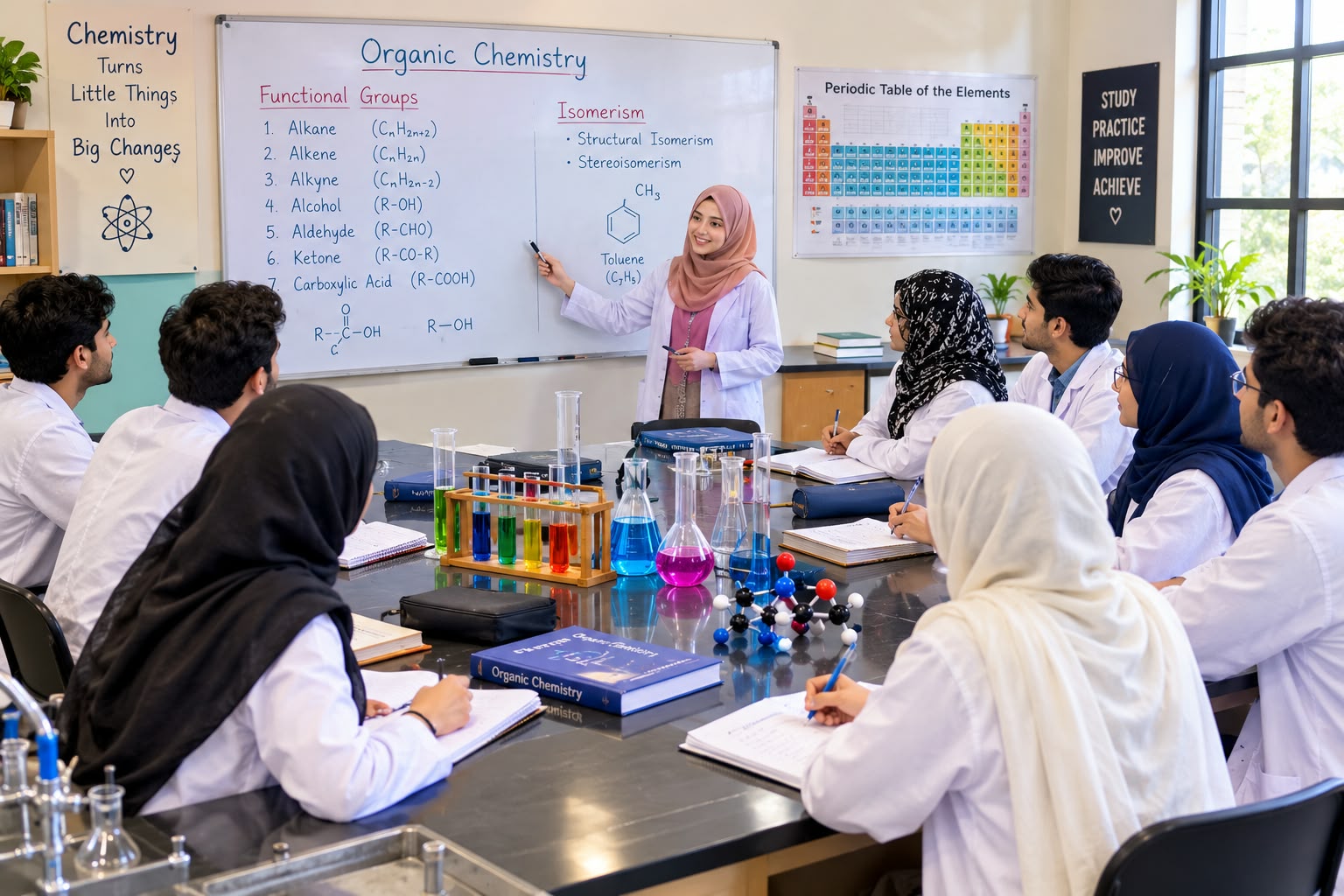
Organic chemistry focuses on carbon-containing compounds, their structures, properties, reactions, and preparation. Students learn concepts that are relevant to pharmaceuticals, polymers, industrial chemicals, and other chemical products.
2. Inorganic Chemistry
Inorganic chemistry deals with metals, minerals, salts, coordination compounds, and other substances. It helps students understand the chemical properties and applications of inorganic materials.
3. Physical Chemistry
Physical chemistry explains the principles behind chemical reactions, energy changes, reaction rates, and the behaviour of matter. Students may study thermodynamics, chemical kinetics, and related concepts.
4. Analytical Chemistry
Analytical chemistry teaches students how to identify substances and measure their chemical composition. These skills are useful in quality control, laboratory testing, industrial production, and research.
5. Biochemistry
Biochemistry explores the chemical processes that occur in living organisms. Depending on the curriculum, students may learn about proteins, carbohydrates, enzymes, and other biological molecules.
6. Environmental Chemistry
Environmental chemistry examines chemical processes in air, water, and soil. It can help students understand pollution, contamination, waste management, and environmental testing.
7. Laboratory Work and Research
Practical laboratory sessions allow students to apply classroom knowledge, use scientific instruments, conduct experiments, analyze results, and prepare laboratory reports. Later semesters may include research projects or specialized laboratory work.
BS Chemistry Fees in Pakistan 2026
The fee for BS Chemistry varies according to the university, city, type of institution, and facilities provided. Public-sector universities may have lower tuition fees than many private institutions, but the total cost depends on the individual university’s fee structure.
Students should consider the following expenses before applying:
- Admission and registration fees
- Semester tuition fees
- Laboratory and examination charges
- Library and other university fees
- Transportation or hostel expenses
- Books, stationery, and laboratory materials
There is no single fee applicable to every university offering BS Chemistry. For accurate information, consult the latest prospectus or official fee schedule of the institution you want to attend.bs chemistry subjects
Students with financial concerns can also ask about need-based assistance, merit scholarships, and other financial support programs.
Best Universities for BS Chemistry in Pakistan
Students can explore chemistry programs at recognized public and private universities across Pakistan. When comparing institutions, consider the quality of teaching, laboratory equipment, research facilities, faculty experience, location, and overall expenses.
You can begin your search by exploring these institutions and verifying their current chemistry offerings:
- University of the Punjab, Lahore
- Government College University, Lahore
- Quaid-i-Azam University, Islamabad
- University of Karachi, Karachi
- Bahauddin Zakariya University, Multan
- University of Peshawar, Peshawar
This is a starting list, not a ranking. Program availability, admission schedules, eligibility requirements, and degree titles should be confirmed directly with each university.
Before enrolling, check the institution’s recognition through the Higher Education Commission of Pakistan.
Scope of BS Chemistry in Pakistan
The scope of BS Chemistry in Pakistan is connected to the country’s pharmaceutical, chemical, food, agriculture, manufacturing, environmental, and laboratory-testing sectors. Chemistry graduates develop scientific knowledge that may be useful in industrial processes, product testing, quality assurance, and research.
However, employment opportunities depend on the graduate’s practical skills, academic performance, work experience, specialization, and the requirements of individual employers.
Graduates who develop laboratory skills, learn to operate relevant analytical instruments, and gain internship experience may improve their employment prospects. Some positions may require postgraduate qualifications or additional professional training.
Jobs After BS Chemistry in Pakistan
After completing BS Chemistry, graduates may apply for suitable entry-level positions in industries, laboratories, research organizations, and educational institutions.
Possible career options include:
1. Chemist
Chemists may work in laboratories or industrial settings, studying substances, analyzing samples, and conducting experiments according to their employer’s requirements.
2. Quality Control Analyst
Quality control analysts help assess whether raw materials and finished products meet established quality standards. They may work in pharmaceutical, food, chemical, and manufacturing industries.
3. Laboratory Analyst
Laboratory analysts perform tests, prepare samples, record results, and assist with chemical analysis. Employers may require experience with specific laboratory instruments and testing methods.
4. Research Assistant
Research assistants support scientific investigations by preparing materials, conducting experiments, collecting data, and maintaining laboratory records. Some research positions may prefer candidates with postgraduate qualifications.
5. Pharmaceutical Industry Jobs
Chemistry graduates may qualify for selected positions in pharmaceutical manufacturing, testing, quality control, and related laboratory departments. Eligibility depends on the job description and relevant regulatory requirements.
6. Environmental Testing Jobs
Environmental laboratories may employ suitably qualified graduates to help test water, soil, and other samples. Additional technical training or experience may be required for specialized roles.
7. Teaching and Education
Graduates may explore certain teaching or educational support positions, depending on the subject, institution, and applicable qualification requirements. Higher-level teaching jobs often require additional education.
Expected Salary After BS Chemistry in Pakistan
The salary of a BS Chemistry graduate depends on the employer, job title, city, industry, experience, and technical skills. Entry-level laboratory positions may offer different salaries from specialized industrial or quality assurance roles.
Rather than relying on a single estimated salary, students should review current job advertisements and compare the qualifications and experience required for each position.
Internships, practical laboratory experience, communication skills, and familiarity with analytical techniques may help graduates become more competitive when applying for jobs.
Higher Education After BS Chemistry
Students who want to specialize in chemistry or pursue research can consider further education after completing their bachelor’s degree.
Possible options include:
- MS or MPhil Chemistry
- Analytical Chemistry
- Organic Chemistry
- Inorganic Chemistry
- Physical Chemistry
- Biochemistry or related interdisciplinary fields
- Environmental science or other relevant postgraduate programs
Admission depends on the university’s eligibility criteria and the relationship between the previous qualification and the intended program. Students interested in academic or research careers should compare postgraduate options early in their degree.
Skills Students Can Develop During BS Chemistry
A successful chemistry student needs more than theoretical knowledge. Practical and professional skills can also be important for further study and employment.
Useful skills include:
- Laboratory safety and chemical handling
- Chemical analysis and sample preparation
- Scientific observation and data recording
- Problem-solving and analytical thinking
- Research and report writing
- Teamwork and communication
- Proper use of laboratory equipment
Students should look for programs that provide sufficient laboratory practice and opportunities to participate in research projects or internships.
Is BS Chemistry a Good Degree in Pakistan?
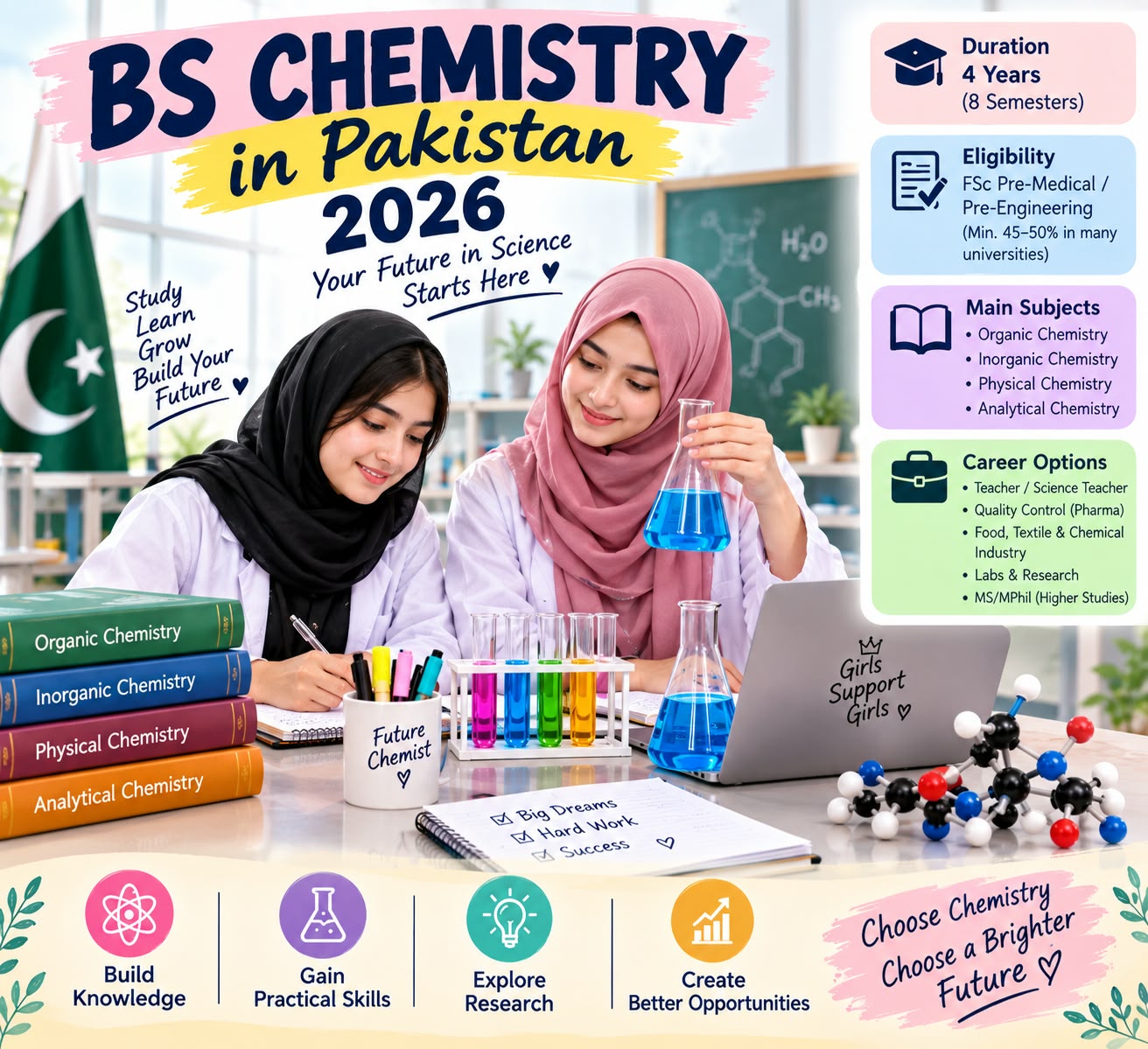
BS Chemistry can be a good choice for students who enjoy science, experiments, laboratory work, and understanding how substances behave. It provides a foundation for careers in chemical analysis, manufacturing, quality control, research, and related fields.
However, students should consider their interests and career goals before choosing the degree. Those who prefer computer programming, business, or other subjects may want to compare alternative qualifications.
You can also explore our guide to BSIT in Pakistan if you are interested in information technology and computing careers.
The best decision is to choose a recognized program with a suitable curriculum, practical facilities, and realistic opportunities for further education or employment.
Documents Required for BS Chemistry Admission
Universities may request different documents during the application process. Commonly required documents include:
- Matric certificate or result card
- Intermediate certificate or result card
- CNIC or B-Form, as applicable
- Recent passport-size photographs
- Domicile, if required
- Equivalence certificate for foreign qualifications, where applicable
- Completed application form and proof of fee payment
Some institutions may request additional documents. Always follow the instructions in the current admission advertisement or online application portal.
Frequently Asked Questions About BS Chemistry
How long is BS Chemistry in Pakistan?
BS Chemistry generally takes four years to complete, although students should confirm the program structure and academic requirements with their university.
Can FSc Pre-Medical students apply for BS Chemistry?
Yes, many universities accept FSc Pre-Medical students, subject to their admission criteria. Students should verify the required subjects and minimum marks before applying.
What are the main subjects in BS Chemistry?
Common subjects include organic chemistry, inorganic chemistry, physical chemistry, analytical chemistry, and laboratory work. Other subjects depend on the university’s curriculum.
Is BS Chemistry available in public universities?
Yes, a number of public-sector universities offer chemistry degree programs. Students should check each university’s current prospectus to confirm the availability of BS Chemistry and its admission requirements.
Can I get a job after BS Chemistry?
Graduates may apply for relevant positions in laboratories, quality control, manufacturing, environmental testing, and research support. Job availability depends on the employer’s requirements, experience, and the graduate’s practical skills.
Can I study MS Chemistry after BS Chemistry?
Students may be eligible to apply for MS or MPhil programs in chemistry or related disciplines, depending on the university’s entry requirements and the applicant’s previous qualification.
Does BS Chemistry have a future in Pakistan?
The degree can provide opportunities in scientific and industrial fields, particularly for graduates who develop practical skills and gain relevant experience. Career prospects vary by sector, location, and market demand.
Conclusion
BS Chemistry in Pakistan 2026 is an option for students who want to build a foundation in chemical sciences and explore careers in laboratories, pharmaceutical and chemical industries, quality control, environmental testing, and research.
Before applying, compare universities, review the curriculum, check laboratory facilities, understand the fee structure, and confirm admission eligibility. Students should also investigate postgraduate opportunities and develop practical skills during their studies.
For more information about degree programs, admissions, and educational opportunities, explore TheReader.edu.pk and choose the academic path that best matches your interests and future goals.