Study in Turkey for Pakistani Students 2026 – Admissions, Fees, Scholarships & Visa Guide
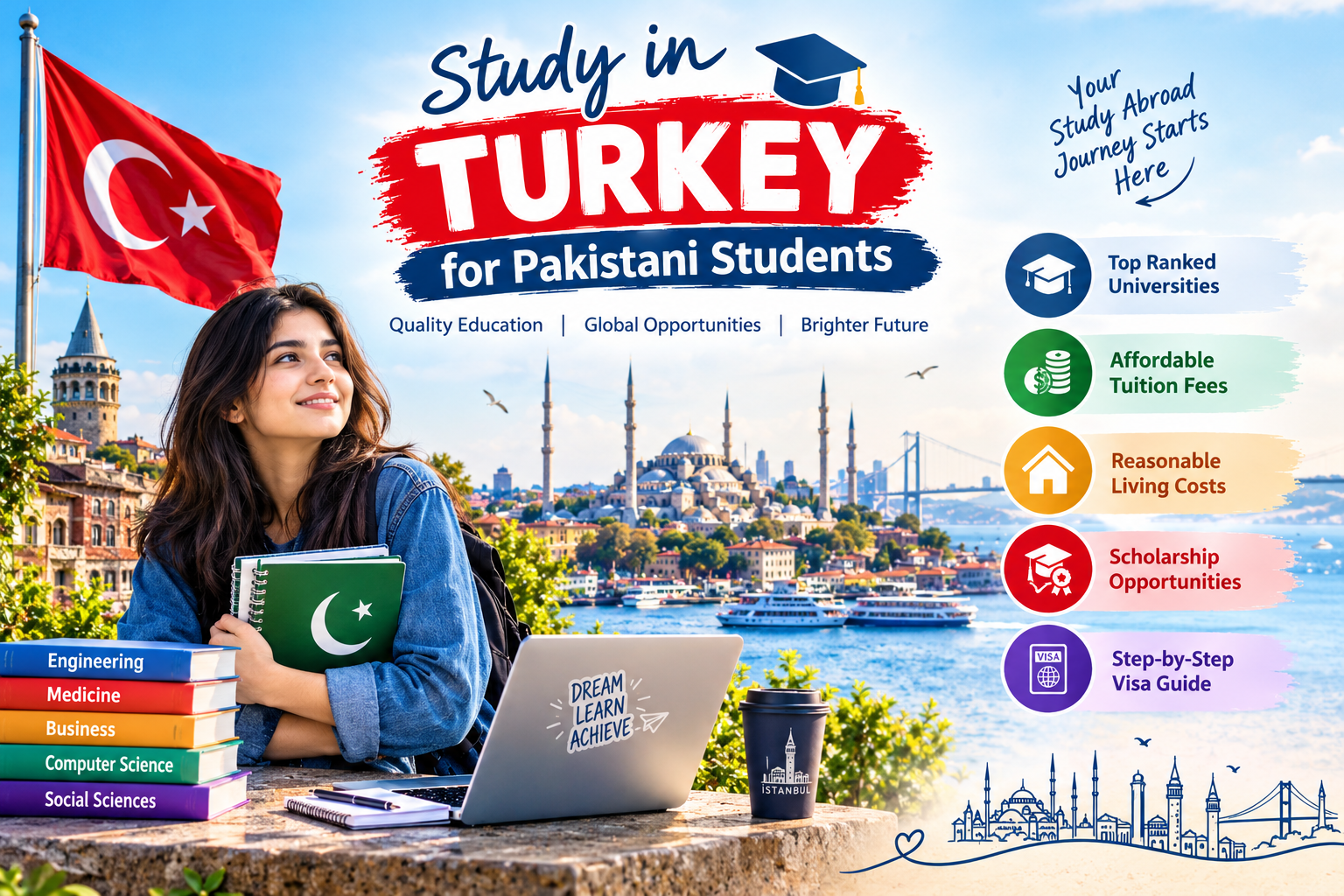
Study in Turkey for Pakistani Students is an attractive option for students who want to pursue higher education abroad in a country that connects Europe and Asia. Türkiye, commonly known as Turkey, offers a wide range of undergraduate, master’s and doctoral programmes at public and private universities. Students can explore different academic fields, experience a new culture and apply for scholarship opportunities.
For Pakistani students, planning to study in Turkey involves several important steps, including selecting a university, checking admission requirements, calculating tuition and living expenses, applying for scholarships and obtaining the appropriate student visa.
This guide explains how Pakistani students can study in Turkey in 2026, covering university admissions, popular study destinations, education costs, accommodation and visa requirements.
Why Pakistani Students Should Study in Turkey
Turkey has become an option worth considering for Pakistani students seeking international educational opportunities. Its location, cultural diversity, range of degree programmes and scholarship options make it a destination to research before making a final decision.
1. A Wide Range of Academic Programmes
Turkish universities offer programmes in engineering, medicine, business administration, computer science, social sciences, humanities, architecture and other disciplines. Students can compare universities according to their preferred subject, teaching language, tuition fees and career goals.
Before applying, students should confirm that their selected degree is recognised and suitable for their intended career in Pakistan or another country.
2. Public and Private University Options
Students can choose between public universities and private foundation universities. Their admission criteria, tuition fees and available programmes can differ significantly.
Public universities may offer comparatively affordable programmes, while private institutions may provide different facilities, English-taught degrees and scholarship arrangements. Applicants should compare the complete cost of each option rather than choosing a university based on tuition fees alone.
3. Scholarship Opportunities
International students can explore government-funded scholarships and university-specific financial assistance. The official Türkiye Scholarships programme offers opportunities at associate, bachelor’s, master’s and doctoral levels.
Depending on the scholarship category and award, benefits may include university placement, tuition coverage, a monthly stipend, accommodation, health insurance and travel support.
Students should read the official eligibility criteria and application calendar before applying through the Türkiye Scholarships official website.
4. Cultural Diversity and International Exposure
Turkey combines historical heritage, modern cities, diverse food traditions and a mix of European and Asian influences. International students can experience a different educational environment while developing communication skills and building relationships with people from different backgrounds.
Learning basic Turkish can also make everyday activities, communication and social integration easier.
5. Student Life in Major Turkish Cities
Cities such as Istanbul, Ankara, Izmir and Bursa offer different educational and lifestyle experiences. Istanbul is a major metropolitan centre, while Ankara is the national capital and an important university city.
Students should compare accommodation, transport, safety, campus facilities and daily expenses before deciding where to study.
Admission Criteria for Turkish Universities for Pakistani Students
Admission requirements vary according to the university, degree level, programme and language of instruction. Pakistani applicants should always check the current international admissions guidelines of their selected institution.
Undergraduate Admission Requirements
Students applying for a bachelor’s degree generally need to complete their intermediate education or an equivalent qualification.
Common requirements may include:
- Matriculation and intermediate certificates or equivalent academic qualifications.
- Academic transcripts and mark sheets.
- A valid passport.
- An online university application.
- A recent photograph.
- An entrance examination score, where required.
- English or Turkish language proficiency evidence, depending on the programme.
- Additional documents requested by the university.
Some universities accept particular international qualifications or examination results, while others may require their own assessment or an examination such as TR-YÖS, where applicable.
Students should not assume that every Turkish university follows the same admission procedure.
Master’s Degree Admission Requirements
Pakistani students applying for master’s programmes usually need a relevant bachelor’s degree or an equivalent qualification.
Depending on the institution, applicants may be asked to provide:
- Bachelor’s degree certificate.
- University transcripts.
- Curriculum vitae (CV).
- Statement of purpose or motivation letter.
- Letters of recommendation.
- Language proficiency results.
- Research proposal for selected programmes.
- Entrance examination results, if applicable.
Some programmes may also require an interview or relevant academic or professional experience.
PhD Admission RequirementsTurkey Student Visa RequirementsTurkey Student Visa Requirements
Doctoral applicants generally need the qualifications specified by their chosen university, often including a relevant master’s degree or an accepted equivalent qualification.
Research-based programmes may require a research proposal, academic references, a CV and evidence of previous research experience. Applicants should contact the relevant graduate school to confirm its exact requirements.
English or Turkish Language Requirements
Some Turkish universities teach programmes in English, while others teach primarily in Turkish. Certain programmes offer a combination of languages.
Applicants may need IELTS, TOEFL or another accepted language assessment if required by their university. The accepted tests and minimum scores vary, so students should verify the rules directly with the institution.
Students entering Turkish-taught programmes may need to demonstrate Turkish proficiency or complete a preparatory language course.
How to Apply to Turkish Universities from Pakistan
Pakistani students can follow these steps to organise their university applications.
Step 1: Choose your degree programme
Identify your preferred field, degree level and career objectives. Compare programmes according to their curriculum, language of instruction, recognition and future opportunities.
Step 2: Research universities
Use the official Study in Türkiye portal to explore universities and available programmes. Visit each institution’s website to confirm international admissions requirements.
Step 3: Check eligibility
Review the required academic qualifications, minimum grades, language proficiency, entrance examinations and any additional programme-specific conditions.
Step 4: Prepare your documents
Arrange your academic certificates, transcripts, passport, photographs and other required documents. Obtain certified translations or attestations if the university or relevant authority requires them.
Step 5: Submit your application
Complete the application through the university’s official admissions portal or the application system specified by the institution. Pay any applicable application fee using the authorised payment method.
Step 6: Apply for scholarships
Research government-funded scholarships and university-specific awards. Check the eligibility criteria, deadlines and funding coverage before submitting an application.
Step 7: Accept your admission offer
If selected, follow the university’s instructions for accepting the offer, paying any required deposit and obtaining official admission documentation.
Step 8: Arrange your student visa
After securing admission, check the current Turkish student-visa requirements for Pakistani citizens. Prepare the required documents and submit your application through the authorised process.
Best Universities in Turkey for Pakistani Students
The following universities are examples worth researching. Their suitability depends on the student’s subject, academic background, budget and preferred language of instruction.
| University | Location | What to explore |
|---|---|---|
| Istanbul University | Istanbul | A broad range of academic disciplines |
| Istanbul Technical University | Istanbul | Engineering, technology and related fields |
| Boğaziçi University | Istanbul | Competitive academic programmes |
| Hacettepe University | Ankara | Health sciences and other disciplines |
| Ankara University | Ankara | Diverse undergraduate and graduate programmes |
| Middle East Technical University | Ankara | Engineering, science and technology |
| Ege University | Izmir | Multiple academic and research fields |
| Dokuz Eylül University | Izmir | A variety of undergraduate and graduate programmes |
| Bursa Uludağ University | Bursa | Different academic and professional disciplines |
| Bilkent University | Ankara | Private university programmes and research opportunities |
Applicants should confirm the current name of the institution, programme availability, admission criteria, language of instruction and tuition fees on the official university website before applying.
Students interested in other education options can also explore courses in Pakistan to compare local and international study pathways.
Study in Turkey Fees for Pakistani Students
The cost of studying in Turkey depends on the institution, degree level, subject, language of instruction and scholarship status.
Public universities and private foundation universities can have substantially different fee structures. Programmes such as medicine, dentistry and certain specialised degrees may cost more than other disciplines.
Public University Tuition Fees
Public universities may offer comparatively affordable options, but tuition fees are not the same across all institutions or programmes.
International students should check the current fee schedule for their chosen degree. Some universities set different fees according to the programme or language of instruction.
Private University Tuition Fees
Private foundation universities may charge higher tuition fees, especially for specialised or professionally oriented programmes.
However, some institutions offer merit-based scholarships, tuition discounts or other financial assistance to eligible students. Students should confirm the award conditions, renewal requirements and final amount payable before accepting an offer.
Other Education Expenses
Tuition is only one part of the total cost. Applicants should also budget for:
- University application and registration charges.
- Academic books and learning materials.
- Health insurance.
- Visa-related expenses.
- Residence permit costs, where applicable.
- Accommodation and utilities.
- Food and local transportation.
- Personal expenses and emergency savings.
Because fees and exchange rates can change, Pakistani students should request the latest official fee information and prepare a budget in both Turkish lira and Pakistani rupees.
Cost of Living in Turkey for International Students
Living expenses depend on the city, accommodation type, lifestyle and current prices. A student living in shared accommodation may have a different budget from someone renting a private apartment in a central area of Istanbul.
Accommodation Costs
Students can investigate several housing options.
University dormitories: University-managed accommodation may offer a convenient option for eligible students. Availability, prices and facilities depend on the institution.
Private student residences: These may provide furnished rooms, shared facilities and additional services. Students should compare the total monthly cost and contract conditions.
Shared apartments: Sharing an apartment with other students can help distribute rent and utility expenses.
Private apartments: Renting an apartment independently provides greater privacy but may involve higher rent, deposits, utility bills and furnishing expenses.
Before signing a housing contract, confirm the location, transport access, payment terms and refund conditions.
Food and Daily Expenses
Students can manage food expenses by preparing meals at home, using university dining facilities where available and planning a monthly grocery budget.
Daily spending will vary according to eating habits, location and personal Student Residence Permit Information preferences.
Transportation
Public transportation is available in major Turkish cities, although routes, fares and student discounts differ. Students should check the current local transport system and eligibility requirements for student travel cards.
Books and Study Materials
The cost of books, laboratory materials, software and other academic resources depends on the chosen programme. Students in technical and health-related fields should check whether additional equipment or materials are required.
How to Prepare a Student Budget
Before travelling, calculate your expected monthly expenses and multiply them by the length of your planned stay. Add tuition fees, visa expenses, insurance, travel costs and an emergency reserve.
Do not rely on an old estimate for an entire semester or academic year. Obtain current accommodation quotes and university fee information to create a realistic budget.
Scholarships in Turkey for Pakistani Students
Scholarships can help reduce the financial burden of studying abroad. Pakistani students should investigate the following options.
Türkiye Scholarships
Türkiye Scholarships is a government-funded scholarship programme for eligible international students. Depending on the programme and award, funding may include university placement, tuition fees, a monthly stipend, accommodation, health insurance, Turkish language education and travel assistance.
The programme covers different levels of higher education, subject to its published eligibility conditions.
University-Specific Scholarships
Some Turkish universities offer their own scholarships or tuition discounts. These may be based on academic merit, programme requirements or other eligibility conditions.
Applicants should check whether an award is available to international students, whether it covers the entire degree or only part of the tuition, and what grades are required to maintain it.
Scholarship Application Tips
- Maintain strong academic results.
- Prepare accurate academic records.
- Write a clear and convincing motivation letter.
- Explain your educational goals and intended field of study.
- Submit all required documents before the deadline.
- Use official application portals.
- Never assume that admission automatically guarantees
- scholarship.
Students should also confirm whether a scholarship covers living expenses, insurance, travel and other costs that are not included in the tuition fee.
Best Student Cities in Turkey
Istanbul
Istanbul is a major metropolitan city with a wide range of universities, cultural attractions and public transport options. Students can compare public and private institutions across different academic fields.
However, accommodation and daily expenses depend heavily on the neighbourhood and lifestyle.
Ankara
Ankara is Turkey’s capital and an important centre for higher education. It offers universities with programmes across science, engineering, social sciences and other disciplines.
Students considering Ankara should compare campus locations, housing and transportation costs.
Izmir
Izmir is a coastal city with several universities and a lively urban environment. It may appeal to students looking for a different lifestyle from the larger metropolitan setting of Istanbul.
Applicants should check the available programmes and the cost of living near their chosen campus.
Bursa
Bursa is another city worth considering for students researching higher education in Turkey. It has universities offering a range of academic programmes and access to local transport and student services.
Compare accommodation, tuition fees and programme suitability before making a final decision.
Student Visa Guide for Pakistani Students
Pakistani citizens holding ordinary passports generally need the appropriate visa to travel to Turkey. Students intending to study should follow the education or student-visa procedure specified by the Turkish authorities rather than assuming that a tourist visa or e-Visa is suitable.
Visa requirements can change, and submitting an application does not guarantee approval.
Documents Commonly Required for a Turkish Student Visa
The exact checklist depends on the applicant and current official instructions. Documents may include:
- A valid passport.
- The official university acceptance or admission letter.
- Completed visa application forms.
- Recent biometric photographs.
- Academic certificates and transcripts.
- Evidence of financial support.
- Bank statements or sponsorship documents, where required.
- Health insurance documents, where required.
- Accommodation or travel information, if requested.
- Additional documents specified by the authorised visa application centre.
Applicants should prepare the documents listed on the latest official checklist. The authorities may request additional evidence depending on the circumstances of an application.
How to Apply for a Turkish Student Visa from Pakistan
Step 1: Secure admission to a Turkish university or educational institution.
Step 2: Review the latest visa instructions issued by the Turkish Embassy, relevant consulate and authorised visa application centre.
Step 3: Complete the required application forms and gather the supporting documents.
Step 4: Book an appointment through the authorised procedure, where required, and submit your application.
Step 5: Pay the applicable visa and service charges according to the official instructions.
Step 6: Wait for the decision before making non-refundable travel arrangement.
Student Residence Permit
A student visa and a student residence permit are different matters. After arriving in Turkey, international students should check the applicable residence requirements and complete the necessary procedures within the required timeframe.
The officiall provides information about residence permits and immigration procedures.
Students should confirm their individual obligations with the relevant authorities and their university’s international student office.
Important Tips Before Moving to Turkey
Before leaving Pakistan, students should:
- Confirm that their selected programme and university meet their academic and professional needs.
- Check degree recognition requirements for their intended career.
- Verify tuition fees and scholarship conditions in writing.
- Arrange suitable accommodation before travelling.
- Prepare a realistic budget for the full academic year.
- Keep copies of their admission, visa and academic documents.
- Learn basic Turkish phrases for everyday communication.
- Understand the rules relating to residence, insurance and any permitted employment.
- Use official university and government websites for important decisions.
- Avoid agents or websites that promise guaranteed admission, scholarships or visas.
Frequently Asked Questions
Is Turkey a good option for Pakistani students?
Turkey may be a suitable option for Pakistani students seeking international education, a range of university programmes and scholarship opportunities. The best choice depends on academic goals, affordability, language requirements and recognition of the selected qualification.
Can Pakistani students study in Turkey on a scholarship?
Yes. Eligible Pakistani students can apply for Türkiye Scholarships and investigate funding offered by individual universities. Selection is competitive, and each scholarship has its own eligibility requirements.
How much does it cost to study in Turkey?
The total cost depends on the university, programme, tuition fees, city and accommodation. Students should calculate tuition, housing, food, transportation, insurance and visa-related expenses using current official information.
Do Pakistani students need IELTS to study in Turkey?
Not necessarily. Language requirements depend on the university and programme. Some English-taught degrees require an accepted English-language test, while Turkish-taught programmes may have Turkish-language requirements.
Can Pakistani students work while studying in Turkey?
Employment rights depend on the student’s status, degree level and applicable Turkish laws. Students should verify the current rules with official authorities before accepting employment and should not rely on part-time work to cover all study expenses.
When should Pakistani students apply to Turkish universities?
Application dates vary by institution, programme and intake. Students should review each university’s official admissions calendar and apply early enough to complete scholarship and visa procedures.
Is a student visa guaranteed after university admission?
No. University admission does not guarantee a visa. Applicants must satisfy the applicable visa requirements, submit the required evidence and wait for the official decision.
Conclusion
Studying in Turkey can offer Pakistani students access to a variety of academic programmes, international experiences and potential scholarship opportunities. However, a successful study-abroad plan requires careful research into university admission criteria, tuition fees, living expenses and visa proceducer.For more educational guidance, explore courses in Pakistan and other study resources available on TheReader.edu.pk