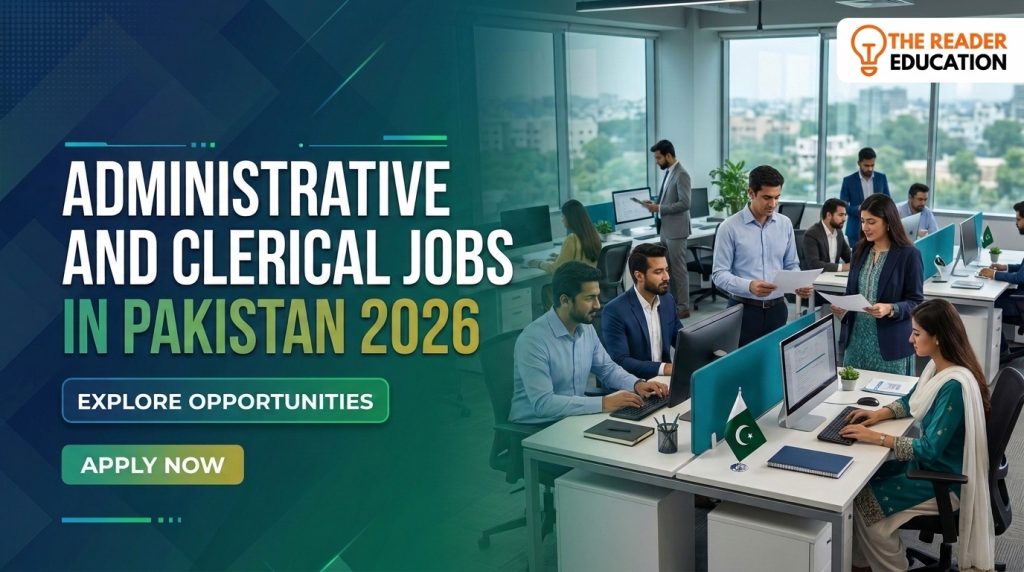
Administrative and clerical jobs in Pakistan provide career opportunities for candidates interested in office management, record- keeping, data entry, communication, and administrative support. These positions are available across different sectors, including government departments, private companies, educational institutions, hospitals, banks, and other organizations. The responsibilities and qualifications depend on the nature of the job and the employer.
Administrative and clerical employees help organizations maintain accurate records, organize documents, communicate with customers, schedule appointments, prepare reports, and manage daily office activities. Some positions focus mainly on routine paperwork, while others involve coordinating departments, supporting managers, and helping improve office operations. Accelerated Action Plan Govt of Sindh Jobs 2026
Candidates who want to start a professional career can explore entry-level positions such as office assistant, junior clerk, receptionist, and data entry operator. Applicants with additional qualifications or relevant experience may also consider administrative assistant, executive assistant, office administrator, and supervisory positions.
This comprehensive guide by TheReader.edu.pk explains the types of administrative and clerical jobs in Pakistan, common duties, eligibility criteria, required skills, possible career paths, application procedures, interview preparation, and ways to identify suitable job opportunities.
What Are Administrative and Clerical Jobs?
Government Clerk Jobs in Pakistan involve activities that help an organization operate efficiently. Although the two categories overlap, they generally differ in the complexity and purpose of their responsibilities.
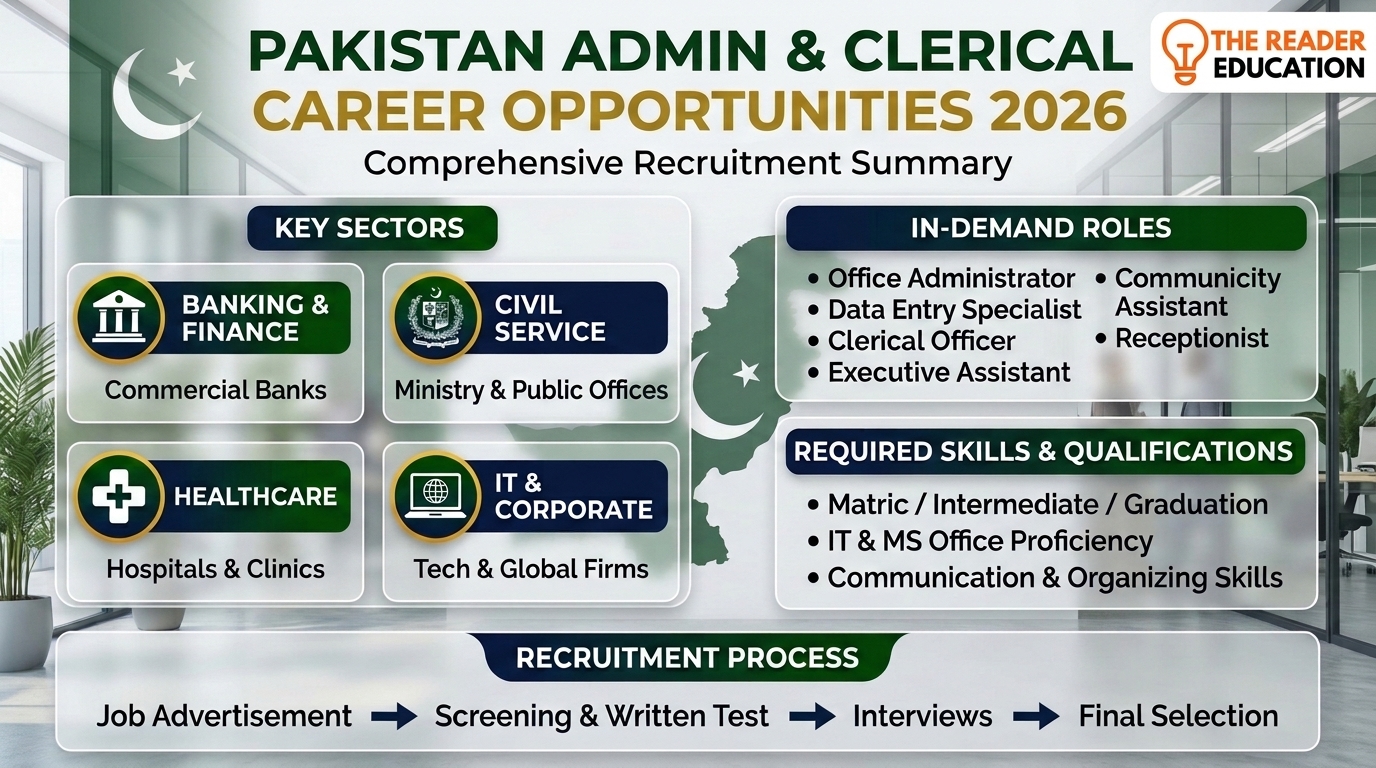
Clerical employees usually handle routine office tasks. Their work may include filing documents, entering data, answering telephone calls, preparing letters, updating registers, and organizing records. These activities help ensure that information remains accurate, accessible, and properly maintained.
Administrative employees often perform broader coordination and management-support duties. They may organize meetings, prepare reports, manage calendars, coordinate office supplies, assist supervisors, communicate with different departments, and monitor the completion of administrative tasks.
For example, a clerk in a school may maintain student records, while an administrative assistant may coordinate meetings, prepare departmental reports, and communicate with teachers and management. In a small company, one employee might perform both types of duties.
The job title alone does not always determine the responsibilities. Applicants should read the complete job description to understand what the employer expects.
Administrative and Clerical Jobs in Pakistan
Admin officer job description and clerical positions can be found in many types of organizations throughout Pakistan. Government offices, private businesses, universities, schools, hospitals, banks, factories, and service companies all need employees who can manage records and support daily operations.
The nature of the work varies by sector. A clerk working in a government department may process official documents and maintain registers, while an office assistant in a private company may handle correspondence, spreadsheets, and customer inquiries.
Educational institutions may require administrative staff to maintain admission records, organize examination documents, and assist students. Hospitals may employ office personnel to manage appointments, organize paperwork, and update administrative records. Businesses may need staff to prepare reports, schedule meetings, and coordinate communication between departments.
Candidates should consider their education, computer knowledge, communication abilities, and preferred working environment before choosing a vacancy.
The following sections explain the main job categories and responsibilities that applicants may encounter.
Types of Administrative and Clerical Jobs in Pakistan
PPSC jobs titles within this field. Some positions are suitable for candidates seeking their first office job, while others require experience, specialized knowledge, or higher qualifications.
1. Junior Clerk
Office assistant jobs for junior clerks generally perform routine clerical duties under the supervision of a senior employee or office administrator. Their work may include maintaining files, entering information, preparing documents, receiving correspondence, and updating registers.
In government departments, junior clerk vacancies may have specific educational, typing, age, and domicile requirements. The exact criteria depend on the department and the recruitment rules applicable to the position.
Candidates interested in junior clerk jobs should develop typing accuracy, basic computer knowledge, document organization, and professional communication skills.
2. Senior Clerk
Senior clerks may handle more complex records and provide support to junior staff. Depending on the organization, they may check documents, maintain departmental registers, prepare summaries, organize correspondence, and assist with routine office procedures. Latest Jobs in Lahore 2026
Some senior clerk positions require previous clerical experience or a specific qualification. Applicants should review the advertisement to determine whether experience is compulsory.
3. Office Assistant
Office assistants help with everyday office operations. Their responsibilities may include arranging documents, answering calls, receiving visitors, preparing photocopies, updating records, and supporting other employees.
This position can provide practical experience for candidates who want to understand office procedures and develop professional skills.
Employers may prefer candidates who can use word-processing software, spreadsheets, email, printers, and scanners. Good organization and reliability are also important.
4. Administrative Assistant
Administrative assistants provide support to managers, departments, and office teams. They may prepare reports, manage appointments, organize meetings, handle correspondence, update records, and coordinate routine administrative tasks.
The role can involve several responsibilities at the same time. Candidates should be comfortable prioritizing assignments, communicating professionally, and maintaining accurate documentation.
Some employers accept applicants with intermediate education and relevant skills, while others require a bachelor’s degree or previous administrative experience.
5. Executive Assistant
Executive assistants work closely with senior managers, directors, or other executives. Their responsibilities may include managing calendars, arranging meetings, preparing presentations, organizing travel information, and handling professional correspondence.
Because this role may involve confidential information and communication with senior staff, employers often look for strong organizational skills, discretion, attention to detail, and relevant experience.
Computer proficiency and the ability to manage changing priorities can also be valuable.
6. Data Entry Operator
Data entry operators enter, update, check, and maintain information in computer systems. They may work with customer records, inventory lists, employee details, financial records, examination data, or other organizational information.
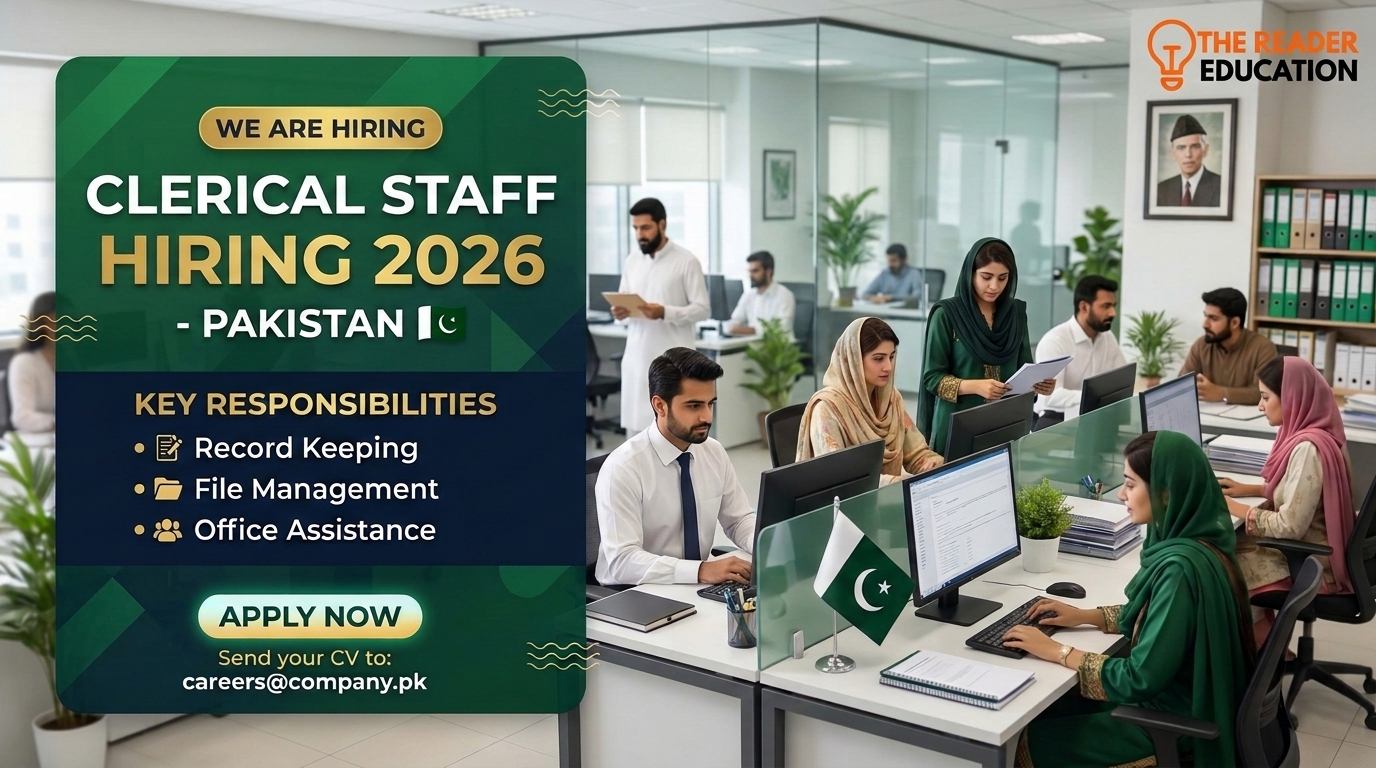
Accuracy is especially important because incorrect entries can create problems for the organization. Candidates should practice typing, learn spreadsheet functions, and understand how to verify information before saving it.
Some employers require a typing test or experience with particular software.
7. Receptionist
Receptionists welcome visitors, answer telephone calls, manage appointments, and direct inquiries to the relevant person or department. They may also maintain visitor registers and help organize meeting arrangements. You can also see Abdul Wali Khan University Mardan Jobs 2026
This role requires professional behavior, clear communication, patience, and the ability to handle several requests politely.
Candidates applying for receptionist positions may benefit from learning telephone etiquette, email communication, basic computer operation, and customer service.
8. Office Administrator
Office administrators help coordinate the overall functioning of an office. Their responsibilities may include maintaining office records, arranging supplies, supporting employees, monitoring administrative procedures, and communicating with service providers.
Depending on the employer, the position may also involve preparing reports, coordinating schedules, assisting with budgets, and supporting office policies.
Employers may prefer candidates with previous office experience and a strong understanding of administrative systems.
9. Records Clerk
Records clerks organize, store, retrieve, and update documents. They may work with paper files, digital records, registers, invoices, forms, and other important information.
The role requires accuracy, consistency, confidentiality, and an organized approach to document management.
Candidates should understand how to label files, maintain records, verify information, and follow the organization’s procedures for storing or sharing documents.
10. Accounts Clerk
Retired clerk jobs and accounts clerks provide basic administrative support to finance or accounting departments. Their work may include recording transactions, organizing invoices, maintaining payment records, entering financial data, and assisting with routine documentation.
Some positions require knowledge of bookkeeping, accounting software, or relevant qualifications. Applicants should not assume that all accounts clerk jobs have the same requirements.
Attention to detail and the ability to handle financial information responsibly are important.
11. HR Administrative Assistant
Human resources administrative assistants help maintain employee records and support routine HR activities. Their duties may include organizing employment documents, updating staff information, scheduling interviews, preparing forms, and assisting with onboarding paperwork.
Some organizations may also ask administrative staff to help arrange training sessions or maintain attendance records.
Because employee records can contain confidential information, professional judgment and discretion are essential.
12. School and College Office Assistant
Schools, colleges, and universities require office staff to support admissions, student records, examinations, correspondence, and other administrative functions.
Depending on the institution, duties may include maintaining student files, preparing notices, updating attendance records, responding to inquiries, and organizing examination documents.
Candidates interested in these jobs should check institutional vacancies and confirm whether the position requires specific qualifications or previous educational-sector experience.
Difference Between Administrative and Clerical Work
Administrative and clerical employees often work together, but their primary responsibilities may differ.
| Clerical Work | Administrative Work |
|---|---|
| Focuses on routine office tasks | Focuses on coordination and management support |
| Includes filing and data entry | Includes planning schedules and coordinating activities |
| Maintains registers and records | Prepares reports and organizes administrative processes |
| May involve answering calls and directing visitors | May involve communicating with departments and managers |
| Usually follows established procedures | May require independent judgment and prioritization |
| Often concentrates on document accuracy | May involve broader responsibility for office efficiency |
These are general distinctions rather than strict rules. In some workplaces, a clerk may perform administrative duties, and an administrative assistant may handle routine clerical tasks.
When applying, read the responsibilities rather than relying only on the job title.
Eligibility Criteria for Administrative and Clerical Jobs in Pakistan
Eligibility criteria vary according to the employer, department, job grade, and responsibilities. There is no single qualification requirement that applies to every administrative or clerical position.
Educational Qualifications
Some entry-level positions accept matriculation or an equivalent qualification. Other vacancies require intermediate education, a diploma, or a bachelor’s degree.
For example, a basic office assistant position may focus on general education and computer skills, while an administrative position in a large organization may require a degree and previous experience.
Specialized roles, such as accounts clerk or HR assistant, may require relevant subject knowledge or training.
Applicants should always confirm the minimum education listed in the official job advertisement.
Typing and Computer Requirements
Clerical vacancies may require candidates to demonstrate typing proficiency or basic computer knowledge. Some positions involve extensive data entry, document preparation, and spreadsheet work.
Depending on the job, employers may ask for a typing test, practical computer assessment, or knowledge of particular office applications.
Candidates should check whether the advertisement specifies a typing speed, software requirement, or computer certificate.
Experience Requirements
Some entry-level positions accept fresh candidates, while others require previous experience in an office or related field.
Experience may be particularly important for executive assistants, office administrators, accounts clerks, and positions involving confidential records or coordination responsibilities.
Applicants should describe any relevant internships, office training, volunteer work, or previous employment honestly in their CV.
Age Limits and Other Conditions
Government recruitment advertisements may specify age limits, domicile requirements, quotas, experience conditions, and other eligibility rules. Private employers may use different recruitment criteria.
Applicants should check the official advertisement and applicable recruitment instructions before applying. Do not assume that the requirements of one department also apply to another.
Essential Skills for Administrative and Clerical Jobs
Employers need staff who can complete office tasks accurately, communicate professionally, and organize information. Developing the following skills can help candidates prepare for administrative and clerical roles.
Communication Skills
Clear communication is necessary for answering questions, responding to emails, preparing letters, and sharing information with colleagues.
Written communication should be professional, grammatically correct, and easy to understand. Verbal communication should be polite and appropriate to the situation.
Candidates can improve these skills by practicing formal emails, learning standard office vocabulary, and developing confidence when speaking with customers or colleagues.
Computer Literacy
Many administrative and clerical jobs involve regular computer use. Candidates should become familiar with common office applications and digital tools.
Useful skills include creating documents in Microsoft Word, entering information in Excel, preparing basic presentations, sending professional emails, managing folders, and printing or scanning documents.
Applicants should also understand basic file organization and learn to save documents using clear, consistent names.
Microsoft Excel and Spreadsheet Skills
Excel is useful for maintaining lists, organizing data, calculating totals, and preparing simple reports.
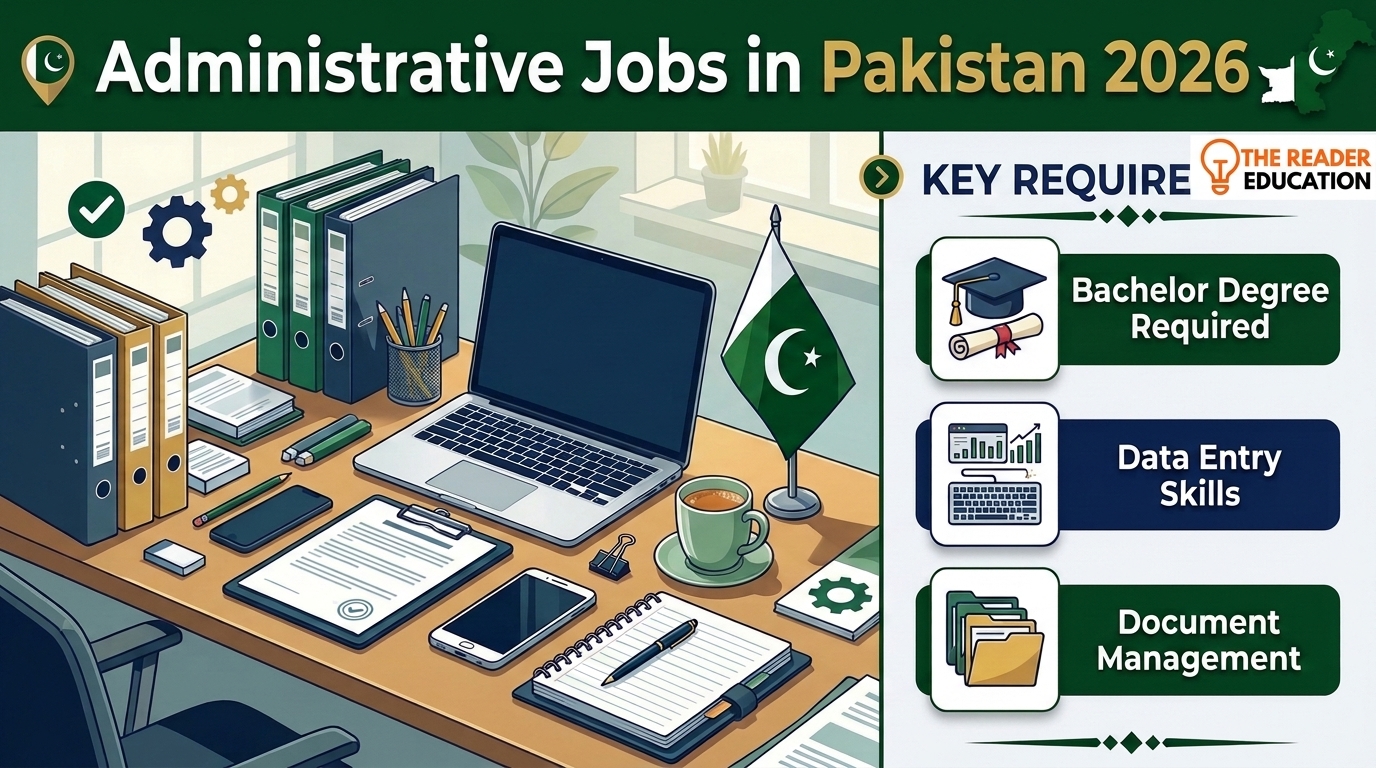
Candidates should learn how to enter data accurately, format cells, sort and filter information, use basic formulas, and create simple tables.
These skills can be particularly helpful for data entry, accounts support, inventory records, and administrative reporting.
Time Management
Office employees may receive several assignments at once. Time management helps them decide which tasks require immediate attention and which can be completed later.
Candidates can practice making daily task lists, setting realistic deadlines, organizing appointments, and checking completed work.
Effective time management should not come at the expense of accuracy or confidentiality.
Organization and Record Keeping
Employees may need to manage physical files, digital folders, forms, registers, and reports. An organized system makes information easier to find and reduces the risk of missing documents.
Candidates should learn how to label records consistently, sort documents logically, update information carefully, and follow the employer’s filing procedures.
Attention to Detail
Small errors in names, dates, numbers, or contact details can create avoidable problems. Employees should review documents before submitting them and verify information against the original source.
For data entry work, candidates can practice checking records and correcting errors without changing accurate information.
Teamwork and Cooperation
Administrative and clerical staff often support several employees or departments. A cooperative attitude helps ensure that tasks are completed smoothly.
Teamwork involves listening, sharing relevant information, respecting workplace procedures, and asking for clarification when instructions are unclear.
Problem-Solving Skills
Unexpected situations can occur in every office. A meeting may need to be rescheduled, a document may be missing, or a computer file may contain incorrect information.
Employees should remain calm, identify the issue, follow established procedures, and seek help when necessary. They should avoid making unauthorized changes to important records.
Confidentiality and Professional Ethics
Administrative staff may handle personal details, financial records, employee information, and confidential correspondence.
Employees should only access information needed for their work and follow the organization’s privacy and security procedures. They should not share confidential files with unauthorized people.
Professional conduct, honesty, punctuality, and respect for workplace rules are important in administrative and clerical positions.
Duties and Responsibilities of Administrative Employees
The daily duties of an administrative employee depend on the organization and job description. Common responsibilities include the following.
Managing Office Documents
Administrative staff may prepare, organize, review, and store official documents. They should ensure that records are complete, accessible to authorized employees, and maintained according to office procedures.
Scheduling Meetings and Appointments
Some employees manage calendars, reserve meeting rooms, send invitations, and notify participants about schedule changes.
They may also prepare agendas, organize documents needed for meetings, and record action points when required.
Handling Correspondence
Administrative employees may prepare letters, respond to routine emails, direct incoming messages, and communicate with customers or colleagues.
They should use professional language and make sure messages reach the appropriate person.
Maintaining Office Supplies
Some roles involve monitoring stationery and other office supplies, recording stock levels, and requesting replacements when necessary.
This helps the organization maintain the materials needed for everyday work.
Supporting Human Resources
Depending on the position, administrative staff may organize employee paperwork, update staff records, schedule interviews, and assist with onboarding or departure procedures.
Sensitive employee information should be handled according to the employer’s confidentiality policies.
Preparing Reports
Administrative employees may collect information from different sources and prepare summaries, spreadsheets, or reports for supervisors.
Accuracy and clear presentation are important when organizing information for management.
Coordinating With Other Departments
Office operations often require cooperation between finance, human resources, operations, customer service, and other teams.
Administrative staff may pass along documents, communicate deadlines, arrange meetings, and follow up on assigned tasks.
Duties and Responsibilities of Clerical Employees
Clerical employees generally focus on routine tasks that support information management and office operations.
Filing and Sorting Documents
Clerks may organize paper files and digital records, label folders, sort correspondence, and retrieve documents when needed.
A consistent filing system makes it easier for authorized staff to locate information.
Data Entry and Verification
Data entry work involves entering information into a computer system and checking that the details match the original documents.
Employees should follow the correct procedures and avoid guessing when information is incomplete.
Answering Calls and Receiving Visitors
Some clerical positions require answering telephone calls, recording messages, directing visitors, and responding to routine inquiries.
Professional behavior helps create a positive impression of the organization.
Photocopying and Scanning
Clerks may prepare copies, scan documents, print forms, and organize digital files. They should check that documents are complete and readable.
Maintaining Registers
Some organizations use registers to track incoming mail, outgoing correspondence, attendance, stock, appointments, or other activities.
Clerical staff may be responsible for updating these records accurately and consistently.
Administrative and Clerical Jobs in Government Departments
Government departments may recruit clerks, assistants, data entry operators, record keepers, and other administrative staff according to their staffing requirements.
The duties and recruitment conditions differ between departments. Some positions involve maintaining official files and processing correspondence, while others focus on computer data, public inquiries, or departmental records.
Government vacancies may specify education, age, domicile, typing ability, computer skills, experience, and selection tests. Applicants should read the advertisement carefully and follow the official application procedure.
Candidates may also need to submit attested documents, complete an online application, or appear for a written or practical test if required.
Do not rely solely on social media posts or forwarded messages. Confirm vacancy details, deadlines, and application instructions through the recruiting department’s official channels.
Administrative and Clerical Jobs in the Private Sector
Private-sector organizations may recruit office assistants, receptionists, administrative assistants, data entry operators, HR assistants, and executive assistants.
These roles can be found in companies, factories, schools, hospitals, software businesses, retail organizations, and service providers.
Private employers often assess practical skills, communication, reliability, computer proficiency, and relevant experience. Some positions may include additional responsibilities depending on the size and needs of the organization.
Candidates should review the working hours, job location, responsibilities, required qualifications, and employment terms before accepting an offer.
It is also sensible to confirm the employer’s identity and avoid opportunities that request suspicious payments or unnecessary personal information.
Where to Find Administrative and Clerical Jobs in Pakistan
Candidates can search for vacancies through several channels.
Official Government Websites
Government departments and public-sector organizations may publish vacancies on their official websites or through authorized recruitment platforms.
Read the full advertisement and confirm the application method, deadline, eligibility requirements, and required documents.
Company Career Pages
Private companies sometimes advertise positions through their official career pages. Candidates can search for job titles such as office assistant, administrative assistant, receptionist, and data entry operator.
Educational Institutions
Schools, colleges, universities, and training institutes may require administrative employees to support admissions, examinations, student records, and office communication.
Applicants should check the institution’s official website or contact the relevant office for recruitment information.
Hospitals and Healthcare Organizations
Hospitals and clinics may recruit receptionists, records clerks, appointment coordinators, and administrative assistants. Some positions may require knowledge of specific record-management systems or healthcare administration procedures.
Reliable Job Listings
Job websites and career information platforms can help candidates discover advertised vacancies. However, candidates should verify important details through the employer or official recruitment source before submitting documents.
TheReader.edu.pk aims to provide useful education and career information. Always check the date and source of any job advertisement because vacancy status and deadlines can change.
How to Apply for Administrative and Clerical Jobs in Pakistan
Following a clear process can help applicants prepare complete applications and avoid common mistakes.
Step 1: Identify Suitable Positions
Search for vacancies that match your education, skills, experience, and location.
Relevant search terms may include administrative jobs in Pakistan, clerical jobs in Pakistan, junior clerk jobs, office assistant jobs, receptionist jobs, and data entry jobs.
Read the job title and responsibilities carefully because similar titles may involve different duties.
Step 2: Review the Eligibility Criteria
Check the minimum qualification, age limit, required experience, typing ability, computer skills, and any additional conditions.
If you do not meet a compulsory requirement, the application may not be considered. When a requirement is unclear, seek clarification from the recruiting organization.
Step 3: Prepare a Professional CV
Your CV should include your name and contact details, educational background, relevant work experience, computer skills, training, and any certifications related to the role.
Keep the information accurate and organized. Highlight skills that match the job description instead of including unrelated details.
Fresh candidates can mention relevant coursework, internships, practical projects, or computer training.
Step 4: Collect the Required Documents
Depending on the vacancy, applicants may need educational certificates, transcripts, identification documents, photographs, domicile, experience certificates, or other supporting materials.
Follow the advertisement’s instructions. Do not submit unnecessary sensitive documents to unverified recruiters.
Step 5: Submit the Application Correctly
Some employers accept online applications, while others request an email, a printed application, or submission through an official recruitment portal.
Use the method specified in the advertisement and make sure the application is complete before the deadline.
Step 6: Prepare for Tests and Interviews
Applicants may be asked to complete a typing test, computer assessment, written examination, or interview.
Practice basic office software, spelling, grammar, data accuracy, professional communication, and common administrative tasks.
Step 7: Follow Up Professionally
If the employer provides a contact method for recruitment inquiries, use it appropriately. Avoid sending repeated messages or contacting unrelated employees about the application.
Keep copies of submitted documents and note the relevant application reference number if one is provided.
How to Prepare for an Administrative or Clerical Job Interview
An interview helps an employer understand your communication style, practical skills, work habits, and suitability for the position.
Candidates should review the job description before the interview and prepare examples that demonstrate relevant abilities.
Common questions may include:
- Tell us about your education and relevant experience.
- Which computer programs can you use confidently?
- How do you organize files and documents?
- How would you handle several tasks with the same deadline?
- What would you do if you noticed an error in a record?
- How would you respond to a difficult customer?
- How do you protect confidential information?
- Why are you interested in this position?
Answer clearly and honestly. If you have not used a particular software application, explain what you know and whether you are willing to learn it.
You can also practice a short typing exercise, prepare a sample spreadsheet, and review how to write a professional email.
Career Growth in Administrative and Clerical Work
Administrative and clerical positions can help employees develop skills that are useful in many professional environments.
A candidate may begin in an entry-level clerical role and gain experience in record keeping, office communication, and computer applications. With further training and suitable experience, the employee may become eligible for positions with broader responsibilities.
Possible career pathways include:
- Junior Clerk to Senior Clerk, where the employer’s structure allows.
- Office Assistant to Administrative Assistant.
- Data Entry Operator to Records or Data Management Support.
- Receptionist to Office Coordinator.
- Administrative Assistant to Office Administrator.
- HR Administrative Assistant to more specialized HR support roles.
These pathways are examples rather than guaranteed promotions. Advancement depends on performance, qualifications, available positions, employer policies, and relevant experience.
Candidates can strengthen their prospects by learning spreadsheet functions, improving written communication, completing relevant training, and gaining experience with office systems.
Salary and Benefits for Administrative and Clerical Jobs
Salaries for administrative and clerical jobs vary according to the position, location, employer, qualifications, experience, and working hours.
An entry-level office assistant may have a different salary structure from an experienced executive assistant or office administrator. Government and private-sector jobs may also offer different pay scales and employment benefits.
Some employers provide additional benefits, such as paid leave, medical coverage, retirement benefits, or transport assistance, while others may offer a different package. Benefits depend on the employer and employment contract.
Before accepting a job, candidates should confirm the salary, payment schedule, working hours, probation period, leave policy, and any benefits mentioned in the offer.
Avoid relying on a single salary estimate for every administrative or clerical position. Check the specific vacancy and discuss unclear terms with the employer.
Common Mistakes to Avoid When Applying
Candidates can improve their application process by avoiding the following mistakes.
Applying Without Checking Eligibility
Submitting an application without meeting the essential requirements can waste time. Read the advertisement before applying.
Sending an Incomplete CV
Missing contact information, unclear qualifications, and unexplained employment gaps can make a CV harder to assess. Review your details before submission.
Ignoring the Application Deadline
Late applications may not be accepted. Note the deadline and allow enough time to complete the required steps.
Providing Incorrect Information
Never invent qualifications, work experience, or computer skills. Employers may verify information during recruitment.
Overlooking the Job Description
A job title may not fully explain the role. Review all listed duties and requirements to understand what the employer expects.
Responding to Suspicious Recruitment Requests
Be cautious if an unknown recruiter guarantees employment in exchange for money or asks for sensitive information without a clear reason. Verify the organization and use official recruitment channels.
Failing to Prepare for Practical Tests
For clerical roles, typing and computer skills may be assessed. Regular practice can help candidates demonstrate their abilities accurately.
Tips for Fresh Candidates Seeking Administrative and Clerical Jobs
Fresh candidates can prepare for entry-level office work even if they have limited professional experience.
First, learn the basics of word processing, spreadsheets, email, and document management. Practice creating letters, entering data, formatting tables, and organizing digital folders.
Second, improve typing accuracy. Speed is useful, but accurate data entry and careful proofreading are equally important.
Third, practice professional communication. Learn how to write clear emails, answer telephone calls politely, and communicate information without unnecessary details.
Fourth, prepare a simple CV that highlights education, computer skills, relevant coursework, training, and practical projects.
Fifth, search for vacancies that explicitly accept fresh candidates. Check the required qualification and location before applying.
Finally, continue learning. Short courses in office management, bookkeeping, computer applications, or business communication may be useful when they match your intended career path.
Frequently Asked Questions About Administrative and Clerical Jobs in Pakistan
1. What are administrative and clerical jobs?
These are office-based roles that support the daily operations of an organization. Clerical work often involves filing, data entry, record keeping, and routine correspondence, while administrative work may include scheduling, reporting, coordination, and management support.
2. What qualifications are required for clerical jobs in Pakistan?
Requirements depend on the employer and position. Some vacancies accept matriculation or intermediate qualifications, while others require a bachelor’s degree, computer training, typing proficiency, or relevant experience.
3. Can fresh candidates apply for administrative jobs?
Yes, some entry-level positions accept fresh candidates. Applicants should look for vacancies that do not require previous experience and ensure they meet the stated education and skill requirements.
4. Which computer skills are useful for clerical jobs?
Typing, Microsoft Word, Excel, email, internet use, file management, printing, and scanning are useful for many clerical roles. Some jobs require additional software or specialized technical skills.
5. What are the main responsibilities of an administrative assistant?
An administrative assistant may manage appointments, prepare documents, arrange meetings, handle correspondence, update records, coordinate supplies, and support managers or departments.
6. Are government clerical jobs different from private-sector jobs?
The responsibilities can overlap, but recruitment rules, qualifications, age limits, application procedures, employment terms, and selection methods may differ. Government applicants should review the official recruitment advertisement, while private-sector applicants should check the employer’s requirements.
7. What is the role of a data entry operator?
A data entry operator enters, updates, and verifies information in computer systems. Accuracy, typing ability, attention to detail, and basic computer knowledge are important.
8. How can I prepare for a clerical job test?
Review typing, spelling, grammar, basic mathematics where relevant, computer applications, and office procedures. Follow the syllabus or test instructions provided by the recruiting organization.
9. Do administrative jobs require experience?
Not always. Some entry-level jobs accept fresh candidates, while senior administrative positions may require previous office experience or specialized qualifications.
10. How can I find current administrative and clerical vacancies?
Check official government recruitment websites, employer career pages, educational institution websites, and reliable job listings. Verify the vacancy date, eligibility requirements, and deadline before applying.
11. What should I include in my CV for an office job?
Include contact details, educational qualifications, computer skills, relevant training, work experience, and other abilities related to the position. Keep the CV accurate, easy to read, and tailored to the vacancy.
12. Can administrative and clerical jobs lead to career growth?
They can provide experience in office systems, communication, records management, and coordination. Further training, relevant experience, performance, and available vacancies may help employees qualify for positions with greater responsibility.
Conclusion
Administrative and clerical jobs in Pakistan offer opportunities for people interested in office management, data entry, document handling, customer communication, and organizational support. These positions are found across government departments, private companies, educational institutions, healthcare organizations, and other sectors.
To prepare for suitable vacancies, candidates should understand the job description, meet the eligibility criteria, develop computer and communication skills, and submit complete applications through reliable channels. Fresh applicants can start by strengthening their basic office skills, while experienced candidates may explore roles involving greater coordination and responsibility.
Before applying, verify the employer, salary details, application deadline, and recruitment requirements. Continue visiting TheReader.edu.pk for educational guidance, career resources, and job-related information to support your professional development.