

BS Statistics in Pakistan 2026 – Scope, Subjects & Fees
BS Statistics in Pakistan is a four-year undergraduate degree that helps students develop the skills needed to collect, analyse, interpret and present data. The degree combines mathematics, probability, statistical methods, research and computer-based data analysis, preparing graduates for careers in banking, finance, healthcare, research, government departments and the technology sector.
According to the Higher Education Commission (HEC) curriculum described in this guide, the revised BS Statistics programme has a minimum of 133 credit hours, including general education, major courses, an internship and a capstone project. Students who have completed Intermediate or an equivalent qualification may be eligible to apply, depending on the admission requirements of their chosen university.
This guide explains BS Statistics eligibility, subjects, admission requirements, specializations, universities, fee structures, career opportunities and options for further education in Pakistan.
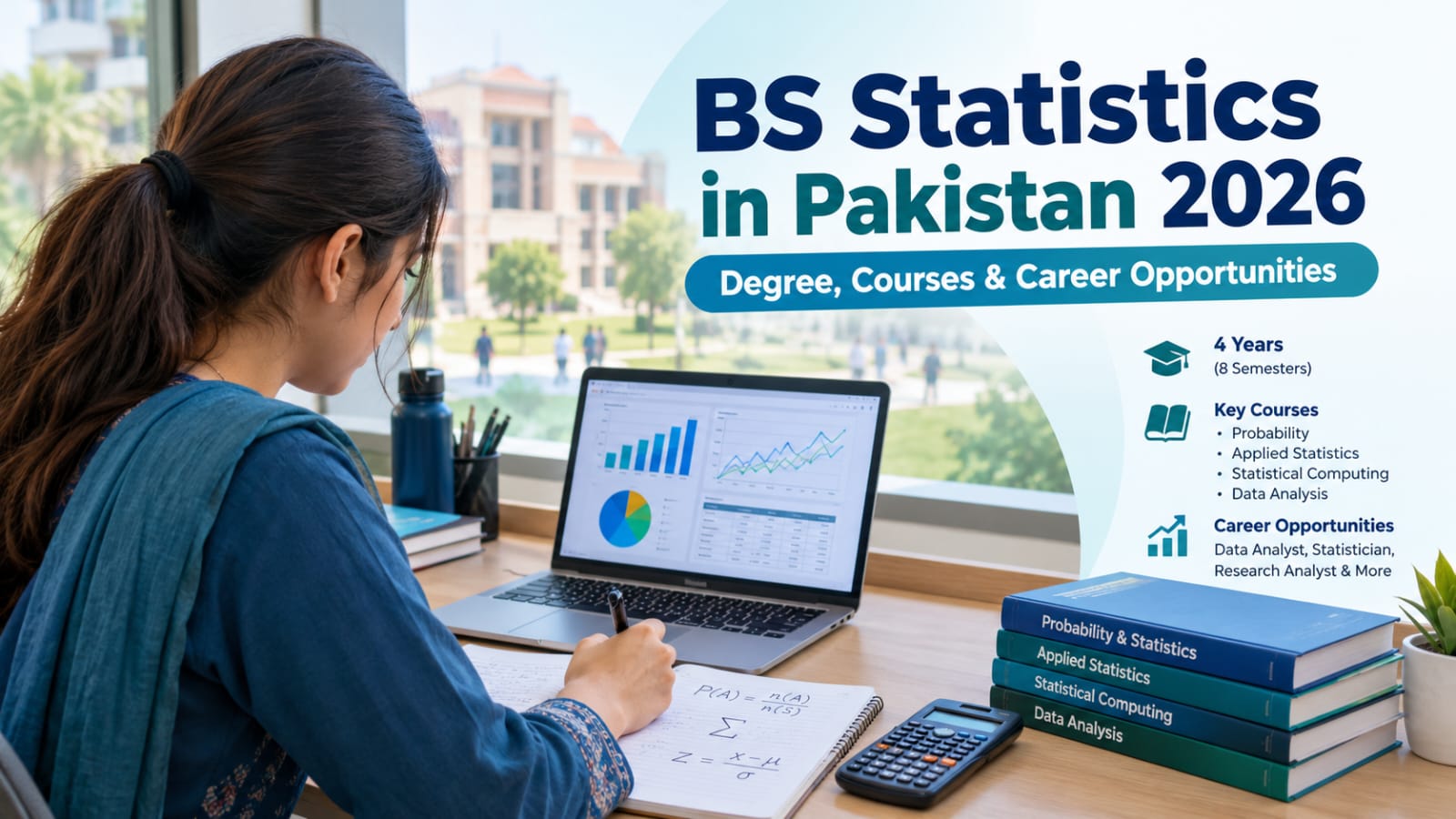
Quick Facts About BS Statistics in Pakistan
| Detail | Information |
|---|---|
| Degree name | BS Statistics |
| Duration | 4 years |
| Semesters | 8 regular semesters |
| Credit hours | At least 133 under the cited HEC curriculum |
| Minimum qualification | HSSC or equivalent, subject to university requirements |
| Major subjects | Probability, statistical inference, regression, sampling and data analysis |
| Specializations | Data Science, Biostatistics and Financial Statistics, where offered |
| Internship | Included in the curriculum |
| Career options | Statistician, data analyst, researcher and related roles |
| Higher education | MS or MPhil in Statistics or a related discipline |
Note: Credit hours, eligibility criteria, course structures and degree requirements should be confirmed through the latest HEC curriculum and the relevant university’s official admission notice.
What Is BS Statistics?
BS Statistics is a bachelor’s degree focused on the scientific study of data. Students learn how to organise information, identify patterns, test assumptions and use statistical techniques to solve practical problems.
For example, statistical methods can help banks assess financial risks, hospitals analyse patient outcomes, businesses understand customer behaviour and government departments prepare population or economic reports.
The BS Statistics degree is a suitable choice for students who enjoy mathematics, logical reasoning, research, and problem-solving. The BS Statistics scope in Pakistan is growing as organizations increasingly rely on data analysis, statistical methods, and evidence-based decision-making. Graduates can explore career opportunities in data analytics, banking, education, research, government departments, and other industries. The degree also provides a foundation for students interested in statistical programming and advanced studies. Students exploring other academic options can visit our guide to courses in Pakistan to compare different degree programmes and choose a field that matches their interests and career goals.bs statistics scope in pakistan
BS Statistics Eligibility Criteria in Pakistan
The minimum eligibility criteria may vary between universities. The HEC curriculum described here allows applicants with an HSSC qualification or an equivalent 12-year education certificate from any group, while individual institutions may require specific subjects or minimum marks.
Common admission requirements include:
- Intermediate, FA, FSc, ICS, I.Com or an equivalent qualification, where accepted.
- A minimum percentage or division specified by the university.
- Mathematics or Statistics at Intermediate level, if required by the institution.
- An entry test or interview, where applicable.
- Academic documents, photographs and other application materials requested by the university.
Can FA and I.Com Students Apply for BS Statistics?
Yes, students from FA or I.Com backgrounds may be eligible at some institutions. However, admission is not guaranteed because universities can impose their own subject requirements.
FSc and ICS students may find more options where mathematics is required. Before submitting an application, check the relevant university’s eligibility criteria, accepted subject combinations and merit calculation policy.
BS Statistics Subjects in Pakistan
The BS Statistics curriculum combines theoretical knowledge with practical data analysis. Students generally study probability, statistical inference, sampling, regression, experimental design and statistical software.
The exact course sequence can differ between institutions.
First Year Subjects
During the first year, students build a foundation in statistics, probability and mathematics.
Typical subjects include:
- Introduction to Statistics
- Introduction to Probability and Probability Distributions
- Introduction to Sampling Theory
- Calculus I and II
- Functional English
- Quantitative Reasoning
- Other general education courses
Second Year Subjects
The second year introduces students to statistical techniques and the analysis of real-world data.
Typical subjects include:
- Basic Statistical Inference
- Exploratory Data Analysis and Visualization
- Introduction to Regression and Analysis of Variance
- Data Wrangling
- Statistical Packages
- Non-Parametric Methods
Third Year Subjects
Students develop a deeper understanding of statistical modelling, research and experimental methods.
Typical subjects include:
- Probability Distributions
- Design and Analysis of Experiments
- Sampling Techniques
- Biostatistics
- Linear Algebra
- Official Statistics
- Statistical Inference
- Regression Analysis
- Elective subjects
Fourth Year Subjects
The final year focuses on advanced applications, statistical programming and independent research.
Typical subjects include:
- Statistical Programming Using R and Python
- Research Methodology
- Statistical Quality Control
- Applied Multivariate Analysis
- Advanced elective courses
- Internship
- Capstone project
Students should consult their university’s approved scheme of studies for the complete subject list and semester-wise credit hours.bs statistics punjab university
BS Statistics Specializations
Some universities allow students to select electives in a particular area of statistics. The available options depend on the department and its curriculum.
1. Data Science
This area focuses on analysing large datasets, identifying patterns and using statistical techniques to support decisions. Related topics may include statistical machine learning, big data analytics and predictive modelling.
It can be useful for students interested in data analytics, business intelligence and technology-related careers.
2. Biostatistics
Biostatistics applies statistical methods to healthcare, medicine, biology and public health research.
Students may explore epidemiology, survival analysis, clinical trials and the interpretation of medical research data.
3. Financial Statistics
Financial Statistics focuses on statistical techniques used in finance, banking, insurance and risk analysis.
Related topics may include financial econometrics, time-series forecasting and actuarial statistics.
Not every university offers all three specializations. Some institutions award a general BS Statistics degree, while others may offer a specialization based on the selected electives.
BS Statistics Admission Process
Admission procedures vary by university, but the following steps can help students prepare.
- Select a university: Compare public and private institutions offering BS Statistics.
- Check eligibility: Review the required qualification, minimum marks and subject prerequisites.
- Complete the application: Submit the online or paper application before the deadline.
- Prepare for admission tests: Take the required test or interview if applicable.
- Check merit lists: Follow the university’s published merit lists and admission updates.
- Confirm admission: Pay the required dues and submit the requested documents before the deadline.
Students should always verify current admission dates directly with the institution. Application deadlines and merit criteria can change from one admission cycle to another.
For more educational updates, visit TheReader.edu.pk’s colleges category.
Universities Offering BS Statistics in Pakistan
Students can explore BS Statistics programmes at public and private universities, depending on the current availability of admissions and the institution’s approved offerings.
Examples of institutions to investigate include:
Punjab
- University of the Punjab, Lahore
- Government College University, Lahore
- Bahauddin Zakariya University, Multan
- University of Sahiwal
- University of Okara
- University of Southern Punjab, Multan
- Minhaj University Lahore
- University of Sialkot
- COMSATS University Islamabad, Lahore Campus
- Government Post-Graduate College, Sahiwal
Khyber Pakhtunkhwa
- University of Malakand
- Abdul Wali Khan University Mardan
Sindh
- Begum Nusrat Bhutto Women University, Sukkur
Distance Learning
Students can also investigate Allama Iqbal Open University to determine whether a relevant programme is currently available through its distance-learning system.
Important: This is a list of institutions to investigate, not a guarantee that every institution is accepting BS Statistics applications in 2026. Programme availability, campus offerings and eligibility requirements should be checked on official university websites before applying. Also verify the institution and relevant programme’s recognition or accreditation status through the appropriate official authorities.bs statistics scope in pakistan
BS Statistics Fee Structure in Pakistan
The cost of studying BS Statistics depends on the university, campus, study shift and applicable fee schedule. Public institutions may have lower tuition fees than many private universities, although the total cost varies.
The following figures are examples reported in the source material and are not independently verified as current 2026 fees.
| Institution | Previously reported fee information |
|---|---|
| Minhaj University Lahore | Reported total package of Rs. 394,000, with instalment details |
| University of Sialkot | Reported tuition fee of Rs. 60,000 per semester, plus admission and registration charges |
| Murray College, Sialkot | Reported BS Statistics morning fee of Rs. 13,335 per semester |
These amounts should not be treated as confirmed current fees. Contact the relevant institution to obtain its latest fee structure.
When comparing universities, check:
- Admission and registration fees
- Tuition fees per semester
- Examination and laboratory charges
- Security deposits and other compulsory charges
- Internship or project-related expenses
- Available scholarships and financial assistance
Students should compare the estimated cost of the entire degree rather than looking only at the first-semester fee.
BS Statistics Scope in Pakistan
The scope of BS Statistics extends across industries that depend on reliable data, quantitative analysis and research. Organisations use statistical techniques to understand trends, measure performance, forecast outcomes and make informed decisions.
As businesses and institutions increasingly rely on data, graduates with strong statistical knowledge and practical technical skills can explore opportunities in several fields.
Career Opportunities After BS Statistics
1. Statistician
Statisticians collect and analyse data, prepare reports and apply statistical methods to support research and decision-making.
2. Data Analyst
Data analysts examine datasets, identify patterns, prepare visual reports and communicate findings to organisations.
3. Research Assistant or Research Analyst
Graduates may support academic, commercial, social science or government research projects by organising data and performing statistical analysis.
4. Biostatistics Professional
With relevant skills and, where required, further education, graduates can pursue opportunities involving healthcare research, clinical studies and public health data.
5. Banking and Financial Analyst
Statistical knowledge can support work involving financial data, risk assessment, forecasting and quantitative reporting.
6. Quality Control Analyst
Manufacturing and other industries use statistical quality-control techniques to monitor production, identify defects and improve processes.
7. Government and Public-Sector Roles
Depending on the advertised post and eligibility requirements, graduates may apply for statistical, research and data-related positions in public-sector organisations.
Employment is not automatic after completing the degree. Many positions require practical experience, specialised software knowledge, competitive examinations or postgraduate qualifications.
Skills That Improve Job Opportunities
Students can strengthen their career prospects by developing skills alongside their university studies.
- R programming: Useful for statistical computing, data analysis and visualisation.
- Python: Supports data processing, automation and analytical applications.
- Excel: Helpful for organising information and preparing reports.
- Statistical software: Learn the tools used in your department and target industry.
- Data visualisation: Present findings through understandable charts and dashboards.
- Research methods: Develop the ability to design studies, interpret results and communicate conclusions.
- Communication: Explain statistical findings clearly to people without a technical background.
Building a portfolio of projects, completing an internship and practising with real datasets can help demonstrate these skills to prospective employers.
Salary After BS Statistics in Pakistan
There is no single salary for BS Statistics graduates. Earnings depend on the employer, city, job responsibilities, technical skills and previous experience.
Entry-level roles may offer different compensation from specialised positions in data analytics, financial modelling or research. Graduates with strong programming abilities and relevant experience may qualify for a wider range of opportunities over time.
Before accepting a position, compare the job description, required skills, benefits and career-development opportunities rather than relying on a single estimated salary figure.
Further Study After BS Statistics
Students who want to specialise or pursue research can consider postgraduate education after completing their bachelor’s degree.
Possible options include:
- MS Statistics
- MPhil Statistics
- Applied Statistics
- Biostatistics
- Data Science
- Econometrics
- Other related quantitative disciplines, subject to admission requirements
Universities may require a relevant bachelor’s degree, a minimum CGPA or percentage, an admission test and additional prerequisites.
Students interested in academic or research careers should review the latest postgraduate admission criteria of their preferred institution.
BS Statistics vs Other Degrees
Choosing the right degree depends on a student’s interests, strengths and career goals.
| Degree | Main focus |
|---|---|
| BS Statistics | Probability, statistical inference, sampling, modelling and data analysis |
| BS Mathematics | Mathematical theory, proofs and advanced quantitative concepts |
| BS Data Science | Data analysis combined with computing, programming and machine learning |
| BS Economics | Economic systems, markets, policy and quantitative economic analysis |
| BS Banking and Finance | Banking operations, financial management, investment and financial analysis |
BS Statistics can be a suitable option for students who enjoy mathematics and want to apply quantitative methods to practical problems. Students who prefer software development may wish to compare computing degrees, while those interested in economic policy may prefer economics.
Explore other degree options through TheReader.edu.pk’s courses guide.
Is BS Statistics a Good Degree in Pakistan?
BS Statistics can be a worthwhile choice for students who enjoy mathematics, logical reasoning and working with data. The degree provides a foundation for statistical research, banking, healthcare analytics, government data work and other quantitative careers.
However, the value of the degree depends on more than the qualification itself. Students should develop practical software skills, complete projects, gain relevant experience and choose electives that match their career interests.
Before applying, compare university recognition, curriculum, faculty, internship opportunities, fees and admission requirements.
Frequently Asked Questions
1. What is the duration of BS Statistics in Pakistan?
BS Statistics is generally a four-year degree consisting of eight regular semesters. The applicable completion period depends on the university’s academic regulations.
2. How many credit hours are required for BS Statistics?
The HEC curriculum described in this guide specifies a minimum of 133 credit hours, with the final structure depending on the approved programme and university requirements.
3. Can ICS students apply for BS Statistics?
Yes, ICS students may apply if they meet the relevant university’s admission criteria. Subject requirements and minimum marks should be checked before applying.
4. Can FA students study BS Statistics?
Some universities may accept FA students, while others require mathematics, statistics or a particular Intermediate background. Eligibility varies by institution.
5. What are the main subjects in BS Statistics?
Major subjects typically include probability, statistical inference, regression analysis, sampling techniques, experimental design, data visualisation and statistical programming.
6. What is the scope of BS Statistics in Pakistan?
Graduates may explore careers in data analysis, banking, finance, research, healthcare, quality control and public-sector statistics, depending on job requirements and individual skills.
7. Can I study Data Science after BS Statistics?
Yes, graduates may be eligible for related postgraduate programmes, subject to the university’s entry criteria. Programming, mathematics and relevant prerequisite courses can be important.
8. Which university is best for BS Statistics in Pakistan?
The best option depends on programme availability, curriculum, faculty, fees, location, practical training and recognition. Students should compare current information from official university websites before making a decision.
Final Words
BS Statistics in Pakistan offers students a pathway into data analysis, research and other quantitative fields. Its combination of mathematics, statistical methods and programming can provide a useful foundation for both employment and postgraduate study.
Before choosing a university, verify the latest admission notice, fee structure, eligibility requirements and approved curriculum. Developing practical skills during the degree can also help students prepare for changing employment opportunities.
Keep visiting TheReader.edu.pk for educational guides, admission updates, university information and career resources.

