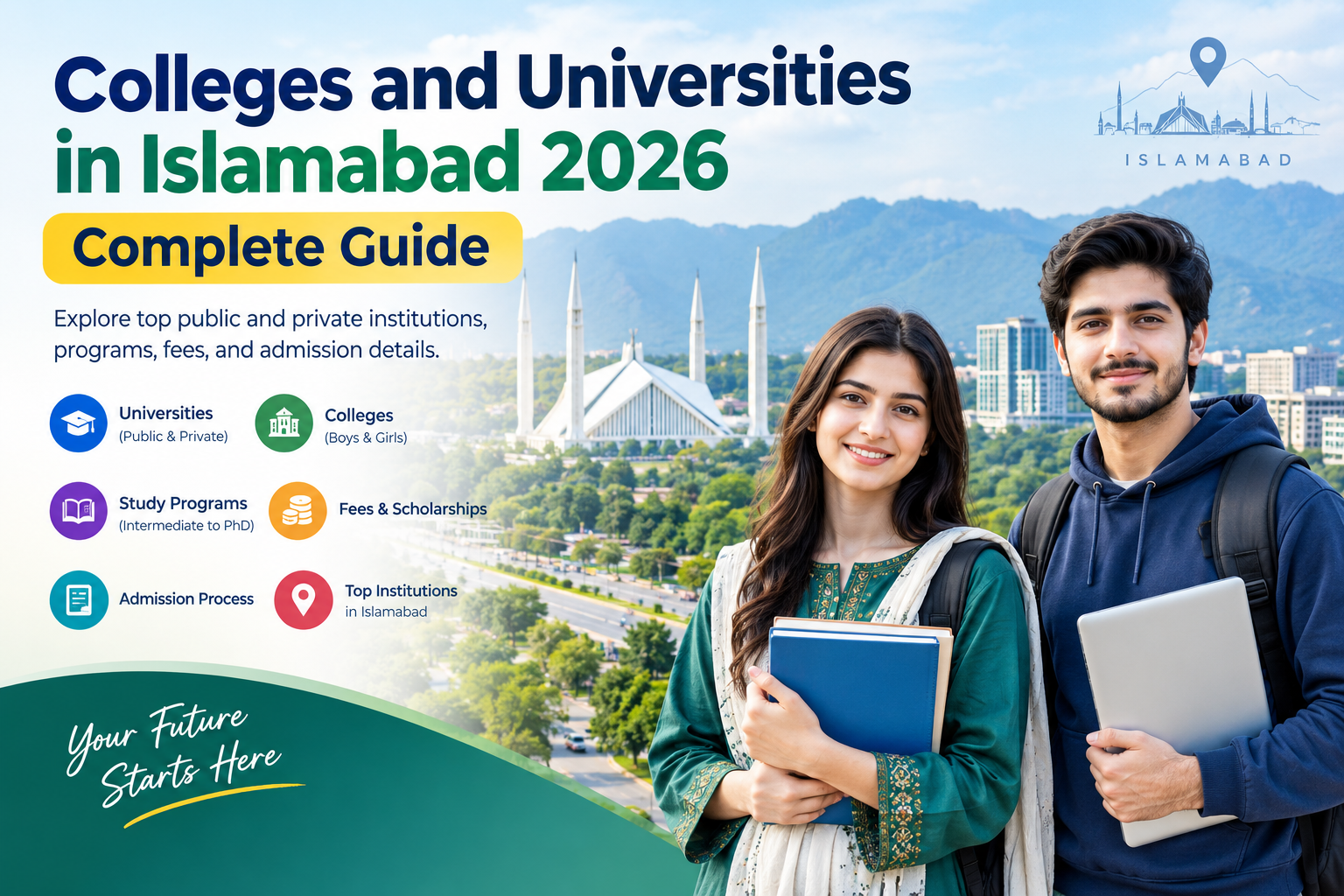
Colleges and Universities in Islamabad 2026 – Complete Guide
Colleges and Universities in Islamabad 2026 – Complete Guide
Colleges and Universities in Islamabad offers a wide range of educational opportunities for students planning to pursue intermediate, undergraduate, postgraduate, and doctoral studies. The city is home to public-sector universities, private universities, degree colleges, professional institutes, and specialized institutions offering programs in medicine, engineering, business, information technology, social sciences, and other academic fields.
Students searching for colleges and universities in Islamabad can explore institutions according to their preferred subjects, budget, location, admission requirements, and future career goals. Whether you are completing matriculation, applying for an intermediate program, or planning to earn a bachelor’s or master’s degree, it is important to compare available options before submitting an application.
This guide by TheReader.edu.pk provides an overview of public and private institutions in Islamabad, popular study options, admission considerations, and practical tips to help students make informed educational decisions in 2026.
Types of Educational Institutions in Islamabad
Educational institutions in Islamabad offer different programs based on students’ academic backgrounds and career interests. Understanding the main categories can help you identify suitable options.
Private Colleges and Universities in Islamabad
Private colleges and universities in Islamabad offer programs across several academic and professional disciplines. Depending on the institution, students may find opportunities in business administration, computer science, engineering, health sciences, media studies, and other fields.
Tuition fees vary according to the institution, degree program, facilities, and study duration. Some institutions also offer scholarships, financial assistance, or installment options to eligible students.
Before applying to a private institution, students should check its recognition status, program accreditation where applicable, admission criteria, total tuition costs, and available facilities.
Government Colleges and Universities in Islamabad
law colleges and universities in Islamabad can explore public-sector institutions that offer recognized qualifications and potentially more affordable education. These institutions provide a range of intermediate, bachelor’s, master’s, postgraduate, and research programs. Available disciplines vary by institution and may include law, humanities, sciences, engineering, languages, business, medicine, and technology.
Public-sector institutions can have competitive admission processes. Students interested in law programs should review LLB eligibility criteria, entrance test requirements, Pakistan Bar Council recognition where applicable, application deadlines, and program-specific admission policies before applying.
Universities in Islamabad
The following table introduces universities and higher education institutions that students can consider when researching study opportunities in Islamabad. The list includes both public and private institutions and is not intended as a verified ranking.
| University | Sector | Popular study areas |
|---|---|---|
| International Islamic University Islamabad (IIUI) | Public | Islamic studies, law, languages, social sciences, business, and computing |
| National University of Modern Languages (NUML) | Public | Languages, translation, management, social sciences, and computing |
| Air University | Public | Aerospace-related studies, engineering, computing, management, and social sciences |
| Riphah International University | Private | Health sciences, computing, management, and social sciences |
| Federal Urdu University of Arts, Science and Technology (FUUAST) | Public | Arts, sciences, computing, business, and Urdu studies |
| Foundation University | Private | Health sciences, computing, management, and social sciences |
| COMSATS University Islamabad | Public | Computer science, engineering, business, and natural sciences |
| Shaheed Zulfiqar Ali Bhutto Medical University (SZABMU) | Public | Medicine, dentistry, allied health sciences, and postgraduate medical education |
| Preston University | Private | Business, computing, management, and related disciplines |
| The University of Lahore, Islamabad Campus | Private | Selected health sciences, management, computing, and other campus-specific programs |
Important: This is an introductory list, not a confirmation that every institution offers every subject listed in 2026. Campus availability, program offerings, recognition, and admission status should be verified through the relevant institution’s official website.
How to Choose a University in Islamabad
When comparing universities, students should consider more than institutional reputation. The following factors can help you make a suitable choice:
- Program recognition: Verify the university and the relevant degree program’s recognition or accreditation status.
- Tuition fees: Compare semester fees, admission charges, examination fees, and other expenses.
- Admission merit: Check the minimum eligibility criteria and previous merit information where available.
- Location and transport: Consider campus accessibility, hostel availability, and commuting costs.
- Career opportunities: Review internship options, practical training, research facilities, and career support.
- Scholarships: Explore financial assistance offered by the institution or eligible external scholarship programs.
Colleges in Islamabad
Islamabad also has colleges and professional institutes offering intermediate education, undergraduate studies, diplomas, and specialized training. The appropriate institution depends on the student’s current qualification and intended field of study.
The following institutions are examples of options students may investigate.
| College or institution | Study focus | What to check |
|---|---|---|
| Islamabad College for Girls, F-6/2 | Girls’ education and college-level studies | Current intermediate and degree offerings |
| KIPS College Islamabad | Intermediate and academic preparation | Available study groups, campuses, and admission criteria |
| College of Medical Technologies, PIMS | Medical technology and related professional training | Current programs and recognition requirements |
| Quaid-e-Azam Postgraduate Medical College | Postgraduate medical education | Eligibility, training pathways, and current admissions |
| Pakistan Institute of Medical Technologies | Medical technology and allied training | Approved qualifications and current course availability |
| Abaseen Institute of Medical and Modern Science | Health-related and professional education | Current programs, recognition, and admission requirements |
| Modern Institute of Informatics and Management | Informatics and management-related education | Available qualifications and relevant accreditation |
The availability of courses and the status of individual institutions may change. Students should confirm current details directly with the institution before paying fees or submitting documents.
Popular Study Programs in Islamabad
Students can choose from a variety of academic pathways depending on their previous qualifications, interests, and long-term career plans.
Intermediate Programs
Students who have completed matriculation may consider intermediate programs such as:
- FSc Pre-Medical
- FSc Pre-Engineering
- ICS (Intermediate in Computer Science)
- ICom (Intermediate in Commerce)
- FA and other humanities programs
Not every college offers every study group. Students should check the relevant board affiliation, subject combinations, practical facilities, and admission requirements.
Bachelor’s Degree Programs
Students who have completed intermediate education may explore undergraduate programs in fields such as:
- BS Computer Science and Information Technology
- Bachelor of Business Administration (BBA)
- Engineering and technology
- Medicine, dentistry, and allied health sciences
- English, social sciences, and international relations
- Accounting, finance, and commerce
Eligibility requirements differ by degree. Programs in medicine, dentistry, and certain engineering disciplines may require specific subjects, entrance tests, or additional regulatory requirements.
Master’s and Postgraduate Programs
Graduates can explore master’s, MPhil, MS, and other postgraduate qualifications, depending on the institution and field.
Common study areas include business administration, computer science, education, economics, engineering, public administration, and social sciences. Doctoral programs are also available at selected institutions for students who meet the relevant research and academic requirements.
Before applying, review the required previous qualification, minimum CGPA or marks, entry test requirements, research proposal requirements where applicable, and program duration.
Admission Requirements for Colleges and Universities in Islamabad
Admission criteria vary according to the institution, academic level, and chosen program. However, students are commonly asked to provide some or all of the following:
- Matriculation, intermediate, or previous degree certificates
- Academic transcripts or mark sheets
- CNIC, B-Form, or other accepted identification
- Recent photographs
- Completed online or paper application form
- Entry test results, where required
- Equivalence documents for qualifications obtained outside the relevant Pakistani education system, where applicable
Some institutions may require interviews, aptitude tests, portfolios, professional registration, or additional supporting documents.
Applicants should use official admission portals and carefully review application deadlines. Meeting the minimum eligibility criteria does not necessarily guarantee admission.
Fees and Scholarships in Islamabad
The cost of education depends on the institution, program, facilities, and duration of study. Public-sector institutions may offer comparatively affordable options, while some private universities charge higher tuition fees. However, costs differ considerably, so students should compare actual fee schedules rather than relying on sector alone.
When preparing an education budget, consider:
- Admission and registration charges
- Tuition fees per semester
- Examination and laboratory charges
- Hostel and transport expenses
- Books, equipment, and other study materials
Students should also check merit-based scholarships, need-based financial assistance, and any institutional fee concessions for which they may qualify. Scholarship availability, eligibility, and award amounts must be confirmed for the relevant admission session.
How to Apply for Admission in Islamabad
Follow these steps when applying to a college or university:
- Select your field: Decide whether you want to pursue intermediate, undergraduate, postgraduate, or professional education.
- Shortlist institutions: Compare public and private institutions offering your chosen program.
- Check recognition: Confirm that the institution and the relevant program meet applicable recognition requirements.
- Review eligibility: Check academic requirements, entrance tests, and other admission conditions.
- Prepare documents: Arrange transcripts, certificates, identification, and any required supporting documents.
- Submit your application: Apply through the official admissions portal or the method specified by the institution.
- Monitor updates: Check merit lists, interview schedules, fee deadlines, and admission announcements.
- Confirm enrollment: Pay the required fees through authorized channels after verifying your admission offer.
Frequently Asked Questions
Which universities are located in Islamabad?
Islamabad has several public and private universities, including International Islamic University Islamabad, NUML, Air University, COMSATS University Islamabad, and Riphah International University. Students should confirm the campus location and current program availability before applying.
Are government colleges in Islamabad more affordable than private colleges?
Government institutions may offer lower tuition fees in many cases, but the actual cost depends on the institution and program. Students should compare official fee schedules and additional expenses before making a decision.
Which colleges in Islamabad offer intermediate education?
Several colleges offer intermediate study groups, including science, computer science, commerce, and humanities. Students should confirm which programs are available at their preferred campus and whether the institution is affiliated with the relevant examination board.
Can students apply to Islamabad universities after completing FSc?
Yes. Students who have completed FSc may apply to eligible undergraduate programs, depending on their subjects, marks, entry test results, and the admission criteria of each university.
Do universities in Islamabad offer scholarships?
Some universities and colleges offer merit-based scholarships, need-based financial assistance, or other fee concessions. Applicants should check the official scholarship policy and application deadlines for 2026.
How can I check whether a university is recognized?
Students should consult the Higher Education Commission of Pakistan (HEC) and the relevant professional regulatory body for the institution and program concerned. For medical and other regulated qualifications, additional program-specific recognition requirements may apply.
Final Thoughts
Choosing among the colleges and universities in Islamabad requires careful consideration of academic interests, admission eligibility, tuition fees, location, and future career goals. Students should compare available programs, check recognition status, and consult official admission announcements before making a final decision.
TheReader.edu.pk aims to help students explore educational opportunities across Pakistan through practical guides, admission updates, and information about colleges, universities, and academic programs. Use this guide as a starting point, then verify current details with your shortlisted institutions before applying for admission in 2026.