MBBS in Pakistan 2026 – Admission, Merit & Fees
MBBS in Pakistan 2026 – Admission, Eligibility, Fee Structure, Merit & Career Scope
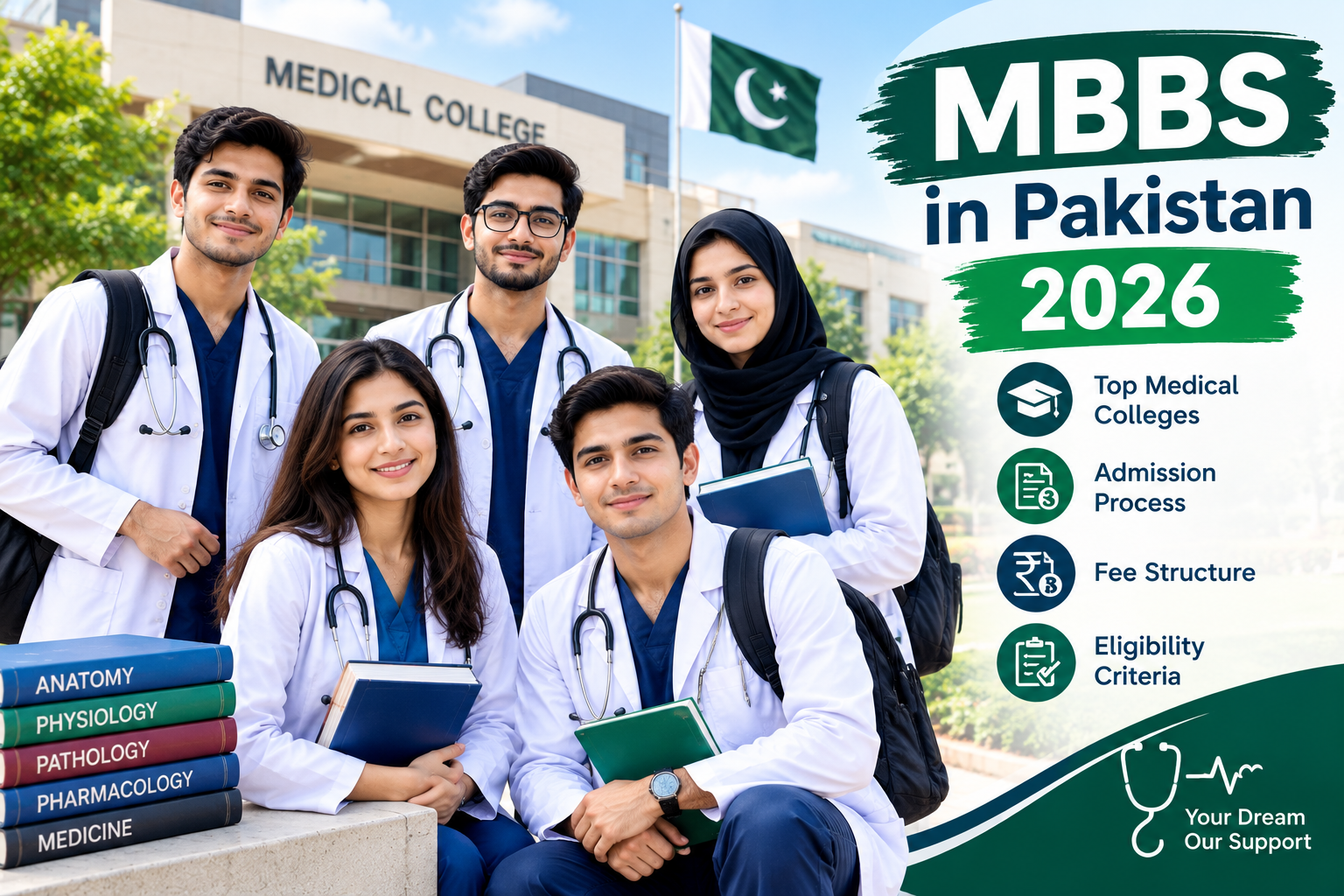
MBBS in Pakistan 2026: is one of the most popular degree choices for students who want to become doctors and build a career in healthcare. The Bachelor of Medicine and Bachelor of Surgery program provides medical education, scientific knowledge, and clinical training to prepare students for the responsibilities of patient care.
Every year, students from different parts of Pakistan apply to public and private medical colleges. However, admission is competitive, and applicants must meet the required academic criteria, pass the Medical and Dental College Admission Test (MDCAT), and follow the applicable admission policy.
In this complete guide, TheReaderPakistan explains MBBS in Pakistan 2026, including eligibility criteria, admission procedures, subjects, fee structure, merit calculation, top medical colleges, career opportunities, and frequently asked questions.nums mbbs admission 2026

What Is MBBS?
MBBS stands for Bachelor of Medicine and Bachelor of Surgery. It is a professional undergraduate medical degree designed to prepare students for careers in medicine.
During the program, students learn about the human body, diseases, diagnosis, treatment, medicines, and patient care. They also receive clinical training to understand how medical knowledge is applied in hospitals and healthcare facilities.
After completing the degree, graduates must fulfil the applicable requirements for provisional or full registration and house job training under the rules of the relevant medical regulator before practising independently.
MBBS Duration in Pakistan
The MBBS program in Pakistan generally takes five years to complete. It includes academic study, practical learning, and clinical rotations.
After graduation, students must complete the applicable house job and registration requirements to progress toward full professional practice. The precise requirements should be confirmed with the Pakistan Medical and Dental Council (PM&DC).
Students should understand that completing the degree alone does not automatically authorize independent medical practice.nums mbbs admission portal
MBBS Eligibility Criteria in Pakistan 2026
Students planning to apply for MBBS admission must meet the eligibility requirements established by the relevant regulatory authority and admission body.
Under the PM&DC undergraduate admission regulations published in 2025, the general requirements include:
- Passing the MDCAT.
- Obtaining at least 60% marks in FSc/HSSC or an equivalent qualification, or a higher percentage if officially notified.
- Passing Biology and Chemistry.
- Passing Physics or Mathematics as the other qualifying subject in the HSSC or equivalent examination.
- Meeting the relevant documentation and admission requirements.
Applicants should verify the latest policy for the 2026–27 admission session because eligibility rules and examination requirements can change.
For official information, visit the PM&DC website.
MDCAT for MBBS Admission 2026
MDCAT is an important entrance examination for students seeking admission to undergraduate medical and dental programs in Pakistan.
The test assesses knowledge and understanding of relevant science subjects and other areas specified in the applicable examination syllabus.
Students preparing for MDCAT should:
- Review the officially published syllabus.
- Practise multiple-choice questions regularly.
- Revise Biology, Chemistry, and Physics.
- Improve time management and accuracy.
- Attempt practice tests under examination conditions.
- Follow official announcements regarding registration, examination dates, and results.
Passing MDCAT is a mandatory admission requirement under the applicable regulations, but it does not guarantee admission. Candidates must also meet the academic eligibility criteria and compete according to the relevant merit and seat-allocation policy.
MBBS Admission Procedure in Pakistan
Public and private medical colleges may follow different application procedures depending on the province, institution, and admission category.
The general process involves the following steps:
- Check eligibility: Confirm that you meet the academic and MDCAT requirements.
- Select medical colleges: Research recognized institutions that offer MBBS.
- Read the admission notice: Check application dates, seat categories, required documents, and the admission policy.
- Complete the application: Submit the online form through the designated admission portal.
- Pay the application fee: Follow the prescribed payment instructions.
- Check merit lists: Review provisional and final selection lists published by the relevant authority.
- Confirm admission: Complete document verification and fee submission within the specified deadline.
For Punjab admissions, students can check the University of Health Sciences (UHS) admission portal. Applicants from other provinces should consult their respective official admission authorities.
MBBS Merit Calculation in Pakistan
MBBS merit is an important factor in the selection process. Students with stronger academic results and MDCAT performance may be more competitive for limited seats.
The merit formula is determined by the applicable admission policy. Candidates should not assume that the same weightage applies every year or in every province.
For example, an admission policy may consider Matric, FSc/HSSC, and MDCAT marks with specified weightages. The exact formula must be checked in the prospectus for the relevant session.
Students should calculate their aggregate using the official formula and compare their results with the published selection lists. Previous years’ closing merits may provide a reference, but they do not guarantee admission in the current session.nums mdcat portal 2026
MBBS Subjects and Course Outline
The MBBS curriculum covers basic medical sciences, clinical subjects, and supervised practical learning. The curriculum and assessment structure depend on the applicable regulatory framework and university.
Common areas of study include:
- Anatomy
- Physiology
- Biochemistry
- Pathology
- Pharmacology
- Microbiology
- Forensic Medicine
- Community Medicine
- Medicine and allied specialties
- Surgery and allied specialties
- Pediatrics
- Obstetrics and Gynecology
- Eye and ear, nose, and throat specialties
- Clinical skills and patient management
Students gradually move from foundational medical sciences to clinical learning. They participate in hospital rotations and supervised activities to develop communication, examination, diagnostic reasoning, and patient-care skills.
MBBS Fee Structure in Pakistan 2026
The MBBS fee structure varies between public and private medical colleges. Fees may also depend on the province, institution, admission category, and applicable regulatory requirements.
Public-sector medical colleges generally offer comparatively lower tuition fees than many private institutions. However, students should check the current official fee schedule rather than relying on old figures.
Before applying, consider the following expenses:
- Admission and registration charges
- Tuition fees
- Examination and university charges
- Hostel and accommodation expenses
- Transport costs
- Books, instruments, and other study materials
- Other institutional charges
Private medical colleges may have substantial total costs, so families should review the complete fee schedule before accepting an offer. Applicants should also verify any officially notified fee limits or requirements that apply to their chosen institution.
Best Medical Colleges and Universities in Pakistan
Pakistan has several established public and private medical institutions. When selecting a college, students should compare its recognition status, teaching hospitals, faculty, facilities, clinical training, location, and fees.
Examples of well-known medical institutions include:
- King Edward Medical University, Lahore
- Allama Iqbal Medical College, Lahore
- Fatima Jinnah Medical University, Lahore
- Services Institute of Medical Sciences, Lahore
- Nishtar Medical University, Multan
- Rawalpindi Medical University, Rawalpindi
- Dow University of Health Sciences, Karachi
- Aga Khan University, Karachi
- Khyber Medical College, Peshawar
- Bolan Medical College, Quetta
This is a general list, not a ranking or confirmation of current admission availability. Students should verify each institution’s current recognition, MBBS program status, and admission requirements through official sources.
Public vs Private Medical Colleges
Both public and private medical colleges can offer routes to medical education, but applicants should carefully compare the total cost and admission requirements.
Public medical colleges
- Often have lower tuition fees.
- May have highly competitive merit requirements.
- May offer access to large teaching hospitals.
- Follow the applicable public-sector admission process.
Private medical colleges
- Set fees according to applicable regulations and institutional policies.
- May have different admission processes and seat categories.
- Can offer clinical training and educational facilities that vary by institution.
- Require careful checking of total costs and recognition status.
The best choice depends on eligibility, merit, finances, location, and the quality of the institution’s medical training.
Career Opportunities After MBBS in Pakistan
An MBBS degree provides a foundation for a medical career. After completing the degree and meeting registration and house job requirements, doctors can explore different professional pathways.
1. Medical Officer
Medical officers provide patient assessment, diagnosis, treatment, and follow-up care in hospitals and healthcare facilities, according to their authorization and responsibilities.
2. Hospital Doctor
Doctors may work in public or private hospitals, clinics, and other healthcare settings after meeting the relevant professional requirements.
3. Postgraduate Medical Training
Graduates may pursue postgraduate training in fields such as medicine, surgery, pediatrics, radiology, dermatology, and other specialties. Entry requirements depend on the relevant training program.
4. Research and Medical Education
Doctors interested in academic work may explore medical research, teaching, public health, and related opportunities, subject to the required experience and further qualifications.
5. Public Health
Some graduates pursue additional education or training in public health, epidemiology, healthcare management, and community medicine.
Career progression depends on professional registration, experience, training, and the requirements of the employer or training institution.
Can Pakistani MBBS Graduates Work Abroad?
Pakistani medical graduates may pursue international opportunities, but an MBBS degree from Pakistan does not automatically grant permission to practise medicine in another country.
Requirements differ by destination. They may include qualification verification, licensing examinations, language proficiency, supervised training, professional registration, and immigration requirements.
Students interested in international careers should consult the official medical regulator in their intended destination before making decisions about examinations or recruitment agencies.

Skills Required to Become a Successful Doctor
Medical students need more than academic knowledge to succeed in clinical practice.
Important skills include:
- Communication with patients and families
- Critical thinking and problem-solving
- Observation and clinical reasoning
- Teamwork with healthcare professionals
- Professional ethics and responsibility
- Time management
- Attention to detail
- Compassion and patience
- Continuous learning and research
Developing these skills during medical school and clinical training can help students prepare for the responsibilities of the profession.
Is MBBS a Good Career Choice in Pakistan?
MBBS can be a suitable choice for students who have a strong interest in medicine, science, and patient care. It offers a structured path toward medical practice and opportunities for further specialization.
However, the journey requires sustained academic effort, practical training, professional responsibility, and continuing education. Students should consider the duration, cost, competitive admission process, and demands of clinical work before choosing this field.
A thoughtful decision based on personal interests, academic strengths, and realistic career planning is more valuable than selecting a degree only because it is popular.
Frequently Asked Questions About MBBS in Pakistan
1. How many years does MBBS take in Pakistan?
The MBBS program generally takes five years. Graduates must also fulfil the applicable house job and professional registration requirements.
2. What is the minimum percentage required for MBBS admission?
Under the PM&DC undergraduate admission regulations published in 2025, the general minimum HSSC or equivalent requirement is 60%, or a higher percentage if officially notified. Students must also meet subject and MDCAT requirements. Always verify the latest admission policy.
3. Is MDCAT compulsory for MBBS?
MDCAT is a mandatory requirement under the applicable admission regulations, subject to any officially specified exceptions for particular admission categories.
4. What subjects are required for MBBS admission?
The general requirements include Biology and Chemistry, together with Physics or Mathematics, as specified by the applicable regulations.
5. Is MBBS cheaper in government colleges?
Public-sector medical colleges generally have lower tuition fees than many private colleges. Actual costs vary, so students should consult the current official fee schedule.
6. Can I get admission to MBBS with a low MDCAT score?
Admission depends on eligibility, aggregate merit, available seats, and the applicable selection policy. Meeting the minimum requirement does not guarantee a seat.
7. What can I do after completing MBBS?
After completing the degree and fulfilling the relevant registration and house job requirements, graduates may pursue medical employment, postgraduate training, research, public health, or medical education pathways.
Conclusion
MBBS in Pakistan is a demanding professional degree for students who want to build a future in medicine. Understanding the eligibility criteria, MDCAT requirements, merit calculation, fees, and admission process can help applicants prepare more effectively.
Before applying for the 2026–27 session, review the latest official announcements from PM&DC and your relevant provincial admission authority. Verify the recognition status of the college, compare total costs, and submit your application according to the official schedule.
For more admission guides, degree information, and educational updates, visit TheReaderPakistan.